
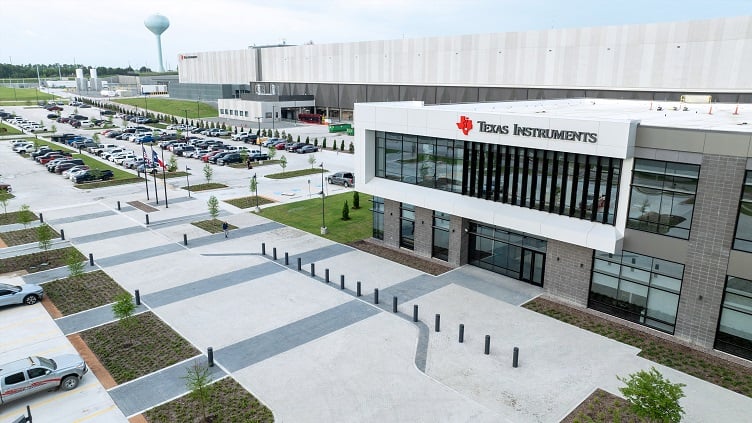
Texas Instruments has started production on its newest 300 mm semiconductor fab, called SM1, in Sherman, Texas.
SM1 will develop analog and embedded processing chips that are used in modern electronic devices.
Brian Dunlap, VP of 300 mm fab operations at TI, told Electronics360 it took just three and half years for SM1 to enter production and the facility will ramp according to customer demand. This means ultimately producing tens of millions of chips daily that go into devices like:
- Smartphones
- Automotive systems
- Healthcare engineering
- Industrial robots
- Smart home appliances
- Data centers
By owning and controlling its manufacturing operations, process technology and packaging, TI has greater control of its supply to support customers.
“Sherman represents what TI does best: owning every part of the technology development and manufacturing process to design and deliver the best, most innovative products for our customers.” Dunlap said. “We have been in the U.S. for nearly 100 years, and are building on our legacy of technology leadership, expanding our U.S. manufacturing presence to help our customers pioneer the next wave of technological breakthroughs.”
SM1 is part of a planned mega-site in Sherman, Texas, with plans for up to four connected wafer fabs that will be constructed, if market demand is there. This will be a potential $40 billion investment at the Sherman facility.
Additional investment in other fabs will come in Utah to support more than 60,000 U.S. jobs and will service customers like Apple, Ford, Medtronic, Nvidia and SpaceX.
 The Sherman, Texas fab is potentially part of a four-fab mega site that will focus on producing semiconductors for the U.S. based companies. Source: TI
What it matters
The U.S. has been looking to expand its semiconductor manufacturing prowess since the early days of COVID-19 when lockdowns caused major supply chain issues in the semiconductor industry for a vast range of applications.
The idea is to create a more resilient and diversified supply chain for electronic chips. The thought is that if another pandemic or geopolitical event happens, the remaining parts of the supply chain will be able to withstand the market forces better.
But it isn’t just the U.S. pushing for more resilient and diversified semiconductor supply chain, other regions like Europe and Japan have embarked on their own investment to bring semiconductor manufacturing back domestically. While this is partially in response to the major chip shortages caused by COVID-19 but also partially due to the aggregation of chip manufacturing currently solely in Asia — specifically, Taiwan, Korea and China.
Another factor in the uptick of regional chip manufacturing is that semiconductors have become a matter of national security due to their inclusion in all modern devices and vehicles. Adding more revenue to a region through chip manufacturing also doesn’t hurt.
As a result of these new plans, the U.S. created the CHIPS and Science Act that started handing out direct funding for chip manufacturing reshoring efforts, including new fabs being constructed by TSMC, GF, Samsung, Micron, TI, Intel and more in the U.S. The European Union created its own investment platform, called the European Chips Act, to encourage investment in semiconductor manufacturing in the region.
As far as TI goes, the company is working on even more investment in the US as part of a larger investment in domestic semiconductor manufacturing.
“TI’s investment in Sherman is part of our company’s broader plans to invest more than $60 billion across seven semiconductor fabs in Texas and Utah – the largest investment in foundational semiconductor manufacturing in U.S. history,” Dunlap said.
