
Analog and mixed-signal chipmaker Texas Instruments will invest more than $60 billion across seven U.S. semiconductor fabs to expand domestic manufacturing capacity for applications ranging from automotive to smartphones to data centers.
The investment comes as semiconductor manufacturing investment is growing again in the U.S. after a pause by the current Trump Administration of funding through the CHIPS and Science Act. TI’s investment follows a planned $200 billion strategic expansion and fab projects from Micron Technology and a $16 billion investment from pure-play foundry GlobalFoundries.
TI said the manufacturing mega-sites that will be located in Texas and Utah will support more than 60,000 U.S. jobs and the company will supply chips to leading vendors like Apple, Ford, Medtronic, Nvidia and SpaceX.
Fab investment
TI said the expansion will include building and ramping seven, large-scale, connected fabs. These fabs will be in Sherman and Richardson, Texas, as well as Lehi, Utah.
All three facilities will manufacture millions of domestically made semiconductors daily.
The Sherman fab, dubbed SM1, is the first new fab in Sherman that will begin initial production later this year after breaking ground three years ago. SM2, the second fab at the Sherman location, has completed construction of the exterior shell. TI said it has started incremental investment plans for two additional fabs, SM3 and SM4, to meet future demand and secure America’s semiconductor supply chain.
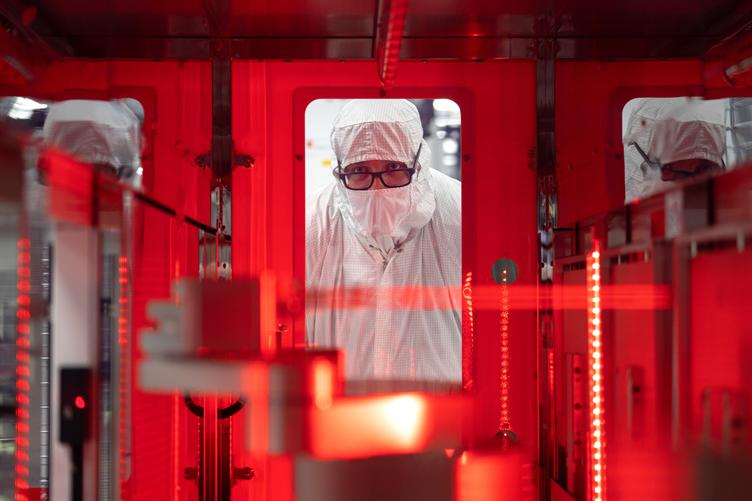
 An employee at one of Texas Instruments’ 300mm semiconductor fabs in Sherman, Texas. TI plans to expand many fabs and build new fabs as part of its $60 billion investment. Source: Texas Instruments
At the Richardson, Texas, location, TI’s second fab, dubbed RFAB2, is ramping to full production and will build on RFAB1, what TI calls the first 300 mm analog fab.
Finally, at the Lehi, Utah, location, LFAB1 is ramping with a 300 mm wafer fab and construction is underway on LFAB2 that will be connected to the first fab.
Last year, TI was granted $1.6 billion in direct funding to fuel the construction of three 300 mm fabs in the U.S. through the CHIPS Act.
Why it matters
Since COVID-19, the U.S., along with other regions like Europe and Japan, has been embarked on an effort to bring back semiconductor manufacturing domestically. This was partially in response to the major chip shortage that the pandemic caused but also partially because COVID showed how aggregating chip manufacturing in a few geographic locations — specifically Taiwan, Korea and China — could be devastating to the supply chain. Particularly if a geopolitical event happens or, in the case of COVID, a pandemic forces the population to shelter in place and workplaces are closed.
The idea is that if the semiconductor supply chain is more diversified, it will be more resilient and better able to withstand these types of issues. The revenue generated from reshoring chip manufacturing back in the U.S. isn’t a bad thing either.
The CHIPS and Science Act was the first major law to start direct funding for these types of semiconductor manufacturing reshoring efforts, including new fabs being constructed by TSMC, GF, Samsung, Micron, TI, Intel and more in the U.S.
While the Trump Administration is renegotiating some of the CHIPS Act funding, the reshoring of semiconductor manufacturing is continuing.
