
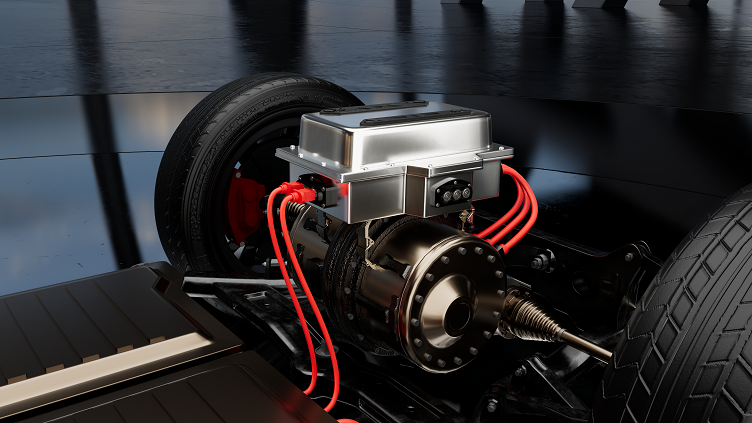
In what is claimed to be an industry first, Texas Instruments (TI) has introduced a multiaxial coreless Hall-effect current sensor targeted at hybrid electric and fully electric vehicles (HEV/EVs).
The coreless Hall-effect sensor, dubbed TMCS2100-Q1, measures the magnetic field in two axes — horizontal and vertical — instead of just one. TI said this type of current sensing eliminates the need to trade between precision and system size in traction inverters.
Single-axis coreless Hall-effect sensors lose accuracy when a vehicle is in operation as vibration causes the movement between the sensor and conductor, leading to errors, the company said. TI’s sensor reduces vibration-induced errors due to measuring magnetic fields both horizontally and vertically simultaneously.
TI claims the multiaxial Hall-effect sensor measurement is 20 times more accurate than single-axis alternatives with a displacement error of less than 1% at 0.4 mm movement and as low as 0.25% at 0.1 mm.
TI said this matters due to the improvements gained by the EV powertrain torque control loop that maximizes efficiency and power delivery across varying loads and thermal conditions.
"Leveraging advanced research from TI’s Kilby Labs — our advanced R&D engine — the TMCS2100-Q1 was developed to give automakers a tool to build HEVs and EVs where tighter current measurement translates directly into longer range, smoother ride quality and more efficient motor control,” said Jason Cole, vice president and general manager of sensing products at TI.
