
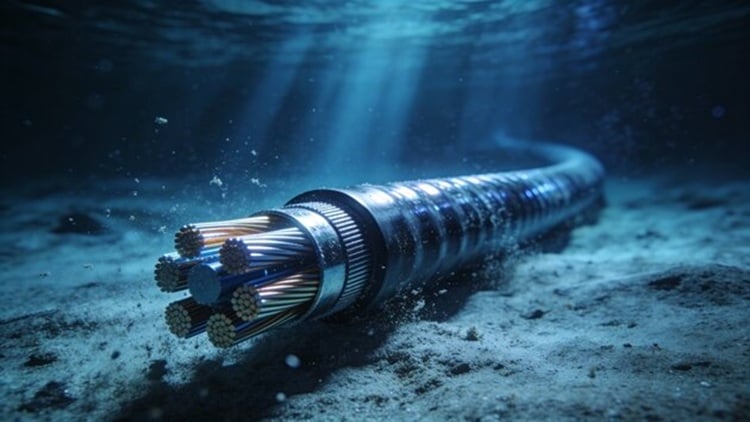
Sea level rise, ocean warming, earthquakes, tsunamis and climate change are all societal issues that can be better understood by looking at the ocean. We do not have the basic data to analyze, comprehend and handle these dangers properly as ocean monitoring is expensive and time-consuming. However, incorporating sensors into upcoming submarine communications cables is one potential answer. SMART cables, which stand for "Science Monitoring and Reliable Telecommunications," are a type of underwater communication line that provide real-time remote sensing of the ocean floor. The potential integration of these sensors into commercially standard telecommunication cables has been the subject of much investigation as part of the worldwide SMART Cable program.
SMART cable capability
A SMART wire can monitor its surroundings in addition to transmitting data with the help of different sensors (e.g., temperature, pressure and three-axis acceleration sensors) placed at the ocean's bottom. Ocean heat content and sea level rise caused by thermal expansion can be better estimated in the context of climate change if the focus is on temperature.
Measuring bottom pressure can help in predicting early warnings of tsunamis, ocean circulation (water flows from high to low pressure) and sea level rise from melting land ice. Seismic motion detection can help for the purpose of early tsunami and earthquake warning systems and a better comprehension of coastal region hazards. By drawing on the knowledge and experience of the submarine cable business, which has been around for almost 200 years, SMART cables are able to offer low-cost, reliable data in real time on a worldwide scale.
SMART cable requirements
Sensors
Within scientific subsystems, sensors could be integrated at a single or numerous sites along the cable. A three-axis accelerometer, a temperature sensor and a pressure sensor are the minimum number of devices used by each scientific subsystem. Depending on other scientific monitoring applications, such as salinity and acoustics/hydrophone sensors, a seismometer and other sensors or devices may be utilized. Systems that merely need to monitor seismic activity could make use of some of the sensors; in this instance, temperature sensors would be redundant. Distributed fiber optic sensing (DFOS) using the optical fiber alone is also a possibility, provided that the land station has the necessary equipment.
Power feeding
In addition to powering the sensors, the scientific subsystem also samples data and handles communication. An increase in power consumption is inevitable when optical underwater transmission cable systems incorporate SMART features. Power feeding equipment (PFE) is designed to handle these extra power demands.
Communication
There are no hard and fast rules about how the system provider must connect the sensors to the ground station(s) in order to transmit data and instructions. To link the scientific monitoring subsystems to the ground stations, dedicated fiber pair(s) could be utilized. The data and directives might also be transmitted between the sensors and the ground stations over in-band or out-of-band channels. Data transmission in the telecommunications and sensor industries must adhere to stringent security protocols. Appropriate safeguards for data transmission must be guaranteed by the system.
Design life and fault isolation
The design life of the communications system will not be affected by the addition of the scientific subsystem. Failures in the latter should not affect the telecommunication system or should only affect the telecommunication system in very rare cases, according to the design of the scientific subsystem. Intervention is not necessary in the event of a scientific subsystem failure.
Both the telecommunications system and the scientific subsystem could have different expected lifetimes. For instance, it might be reasonable to let sensors lose their calibration prior to the telecommunication system's 25-year design life. This could be justified by the idea that a new cable will have been laid along the same route before then, or by the fact that external calibration can be carried out (for instance, using instruments that are lowered from ships or autonomous underwater vehicles). Throughout its entire design life, the system must maintain the required communication performance.
Maintenance
There must be zero interference between the scientific subsystem and the capacity to retrieve and fix the underwater cable mesh. Recovery and restoration of the system over its lifetime can be accomplished using a range of vessels and methods. System designers must take the scientific subsystem's increased mass into account when making adjustments to recovery conditions to make sure they stay within reasonable bounds. There will be no way to fix the damage that the repair procedure did to the scientific subsystem, that much is certain. To illustrate the point, repeaters can be re-positioned or re-oriented without any effort to restore the original installation settings.
Environmental and deployment requirements
All aspects of the scientific subsystem's design, including its transportation, installation and operation, must adhere to the same environmental standards as the entire telecommunication cable system. Optical transmission underwater cable installation technologies that are currently in use must be compatible with the scientific subsystem.
System operation
The functioning of the telecommunications submarine cable system, including element management, network management and supervisory performance, must not be affected by the incorporation of scientific subsystems.
Timing and monitoring
The scientific subsystem relies heavily on timing and synchronization. Sensor data is recorded by the scientific subsystem at a specific time, which is usually Universal Time Coordinated or another appropriate external reference. The maintenance controller allows the land stations to control and monitor the state of each scientific subsystem.
Sensor data processing and storage
The client can access the stored sensor data through an interface provided by the network management system. The temperature, acceleration and pressure are all expressed in their SI units.
Conclusion
SMART submarine telecommunications cables are equipped with environmental sensors (pressure, temperature, seismic acceleration) in oceans to monitor ocean bottom conditions for climate study and early warning systems for tsunamis and earthquakes. There are no known technological hurdles to implementing these cable systems, but it is obvious that engineering development and the resolution of the associated practical challenges are necessary.
