
Scientists at Nanyang Technological University, Singapore (NTU Singapore) have created an automated cyborg insect "factory line."
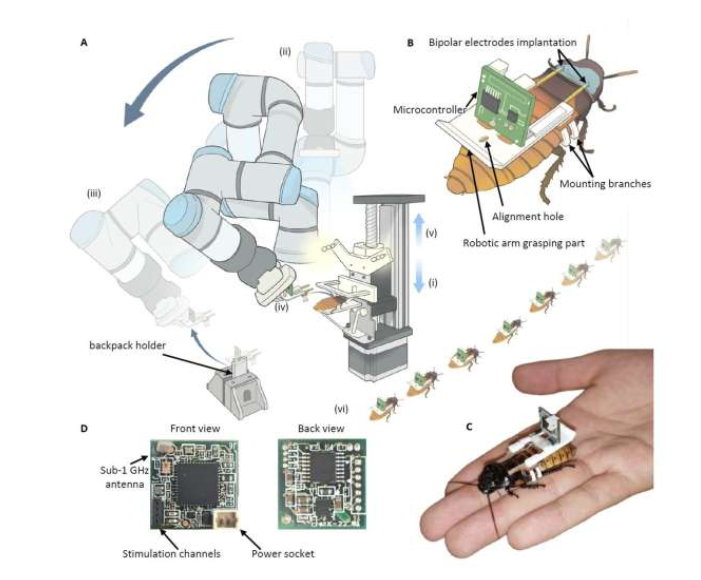
According to its developers, the new prototype artificial intelligence (AI)-powered robotic system automates how miniature electronic backpacks are attached to the backs of Madagascar hissing cockroaches, thus turning them into insect-hybrid robots.
 Source: Nanyang Technological University
Capable of attaching the electronic backpacks to the Madagascar hissing cockroaches in just 1 minute and eight seconds per insect, the new automated assembly method dramatically reduces preparation time as well as human error. This promises to make the large-scale deployment of insect-hybrid robots in complex environments for search and rescue efforts in disaster zones closer to reality, the researchers suggest.
When performed manually, the process of attaching the electronic backpacks to Madagascar hissing cockroaches takes much longer — reportedly 60 times longer than the automated process.
"Manual preparation is time-consuming and very dependent on skilled operators. By automating the process, we can produce insect-hybrid robots rapidly and consistently. It will allow us to prepare them in large numbers, which will be critical in time-sensitive operations such as post-disaster search and rescue."
To add the backpacks, the robotic assembly system relies on computer vision and a proprietary algorithm to identify the ideal anatomical site on the cockroach's back for electrode implantation, thereby ensuring accurate placement.
"With learning from our field deployment, it's now essential to create infrastructure that supports mass production and deployment," the researchers explained. "Our assembly line is the first step toward that goal, and we believe it will pave the way for more reliable cyborg applications, such as inspecting large civil structures for defects."
An article detailing the assembly line, “Cyborg insect factory: automatic assembly for insect-computer hybrid robot via vision-guided robotic arm manipulation of custom bipolar electrodes,” appears in the journal Nature Communications.
