
A team of engineers from Rice University have developed a flexible octopus-like robot arm that is controlled by laser beams.
According to the engineers, the soft robotic arm can reportedly handle complex tasks, ranging from navigating around obstacles to precisely hitting a ball.
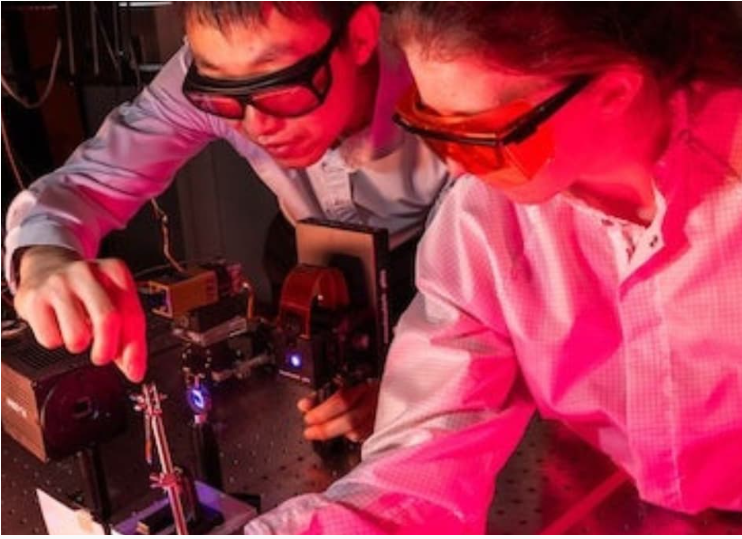 Source: Jeff Fitlow/Rice University
“This was the first demonstration of real-time, reconfigurable, automated control over a light-responsive material for a soft robotic arm,” the researchers explained.
The team envisions that this development could potentially be employed in various fields, from implantable surgical devices to industrial machines.
Enabling this robot to move is a light-responsive material called azobenzene liquid crystal elastomer. This polymer reacts to light, first by shrinking under blue laser light and then by swiftly relaxing and regrowing in the dark.
When light is shone on one side of the material, the shrinking encourages the material to bend in that direction. The material bends toward laser light similar to how a flower stem does toward sunlight, the researchers added
Using a spatial light modulator, which is a specialized device, the team divided a single laser beam into several “beamlets,” each of which offers versatile control. In other words, the beamlet can be aimed at assorted parts of the arm, its intensity can be modified and it can be toggled on or off. As such, the robotic arm can flex or contract at any desired location, much like the fluid movements of an octopus’s tentacles.
Enabling the light-controlled robot to perform complex tasks like navigating an obstacle or hitting a ball, the team used machine learning technology. Specifically, the team developed a convolutional neural network (CNN), a kind of artificial intelligence (AI) used in image recognition. The team trained the CNN by introducing different light patterns and the resulting arm movements.
“This is a step towards having safer, more capable robotics for various applications ranging from implantable biomedical devices to industrial robots that handle soft goods,” the team concluded.
The findings are detailed in the article, “Spatiotemporally Controlled Soft Robotics with Optically Responsive Liquid Crystal Elastomers,” which was published in the journal Advanced Intelligent Systems.
