
The Department of Commerce (DOC) is methodically building out the pieces to unblock AI compute bottlenecks at scale through a fast-accelerating series of CHIPS Act R&D awards.
The latest: $874 million spread across seven companies that run the gamut of high-performance AI memory; co-packaged optics (CPO) and silicon photonics; advanced packaging; thermodynamic sampling units (TSUs); cybersecurity technologies for AI and supply chains; and photonic interconnects.
Specifically, the funds were given to:
- GlobalFoundries — up to $300 million for CPO and silicon photonics.
- Kepler Compute — up to $245 million for the development of high-performance AI memory technology.
- Multibeam Corp. — up to $140 million for advanced packaging technology.
- Extropic — up to $75 million for TSUs.
- Thintronics — up to $50 million to develop ultra-low-loss inter-layer dielectrics for semiconductor interconnects and advanced packaging.
- OBSIDIA Semiconductors — up to $34 million for non-invasive counterfeit and malicious component identification systems for AI and the electronics supply chain.
- Aeluma — up to $30 million to develop large-diameter, indium phosphide (InP)-free substrate technology for photodetectors and lasers used in AI photonic interconnects.
All told, these technologies will go after the AI compute bottleneck from a variety of angles from raw silicon to the usable AI compute processes.
"Accelerating R&D for domestic photonics capabilities, novel memory architectures, advanced packaging, substrates, and other technologies will provide American industries the extreme bandwidth and energy efficiency to scale complex AI workloads securely and rapidly," said Bill Frauenhofer, executive director for semiconductor innovation and investment at the DOC.
Additionally, as with other types of recent CHIPS Act funding, all these investments include some type of equity given to the U.S. government.
Other funding
This is only the beginning of recent DOC funding tied to the future of AI development in the U.S. Over the past several months of 2026, companies have been awarded funding through the CHIPS Act to build on technologies that will be used for AI development.
Earlier this month, Bosch signed an agreement to add up to $225 million in direct funding from the DOC to support Bosch's $2 billion investment to transform a fab in Roseville, California, where it will produce silicon carbide (SiC) semiconductors. SiC semiconductors are increasingly being used in AI data centers to improve performance of data racks as well as manage power more efficiently.
In June 2026, the DOC awarded $500 million to SandboxAQ to accelerate the development of AI-driven materials and up to $50 million in direct funding to Coherent Corp. to expand its facility in Sherman, Texas.
In May 2026, the U.S. government invested in nine quantum computing companies and chipmakers totaling $2.01 billion. The move is designed to give the U.S. a domestic foothold in the emerging technology. Part of the investment came from the CHIPS Act to IBM to give up to $1 billion in direct funding to create Anderon, a quantum chip foundry spun off from IBM.
Extropic's funding
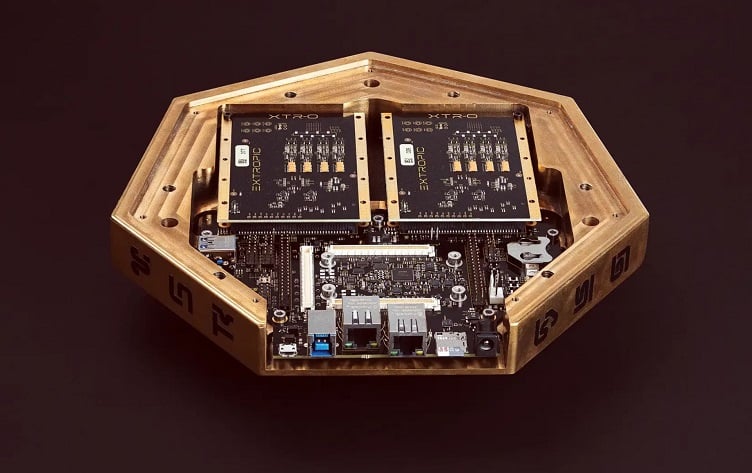
Extropic, an American maker of thermodynamic computing hardware, signed a letter of intent with the DOC for up to $75 million with the CHIPS Research & Development Office (CRDO).
The funding from the DOC is designed to speed up Extropic's TSU development. The funding will also qualify the company for a domestic manufacturing path for its technology.
TSU, a so-called new category of semiconductors for probabilistic AI workloads, uses natural thermodynamic fluctuations of standard complementary metal-oxide-semiconductor (CMOS) transistors to sample directly from programmable probability distributions in an efficient way. This can extend inference for physical intelligence and defense, where robots, autonomous systems and sensor platforms must reason in real time. TSU can also achieve energy-efficiency gains of orders of magnitude over conventional graphics processing units (GPUs).
Aeluma's funding
Semiconductor maker Aeluma received $30 million in proposed funding through the CHIPS Act for the development of a non-InP semiconductor manufacturing platform for photonics.
The company called this development an important technology for the U.S. economy and national security. The compound semiconductors would help in the scaling of photonic components like high-speed photodetectors and lasers that would be used in AI, advanced computing and other applications.
The funding would help to accelerate a domestic U.S.-based production source of these electronic components.
Thintronics funding
Under the $50 million CHIPS incentives to Thintronics, the company will accelerate the commercialization of its ultra-low-loss substrate interlayer dielectric (ILD) platform. This will be used in AI, high-performance computing (HPC), advanced networking and chiplet-based semiconductor packaging.
Thintronics said about 98% of the world's advanced substrate ILD market is supplied by a single foreign company. This creates supply chain vulnerabilities, the company said. Thintronics would establish a domestic supply of these technologies in the U.S.
Multibeam's funding
Through the $140 million in proposed federal funding from the CHIPS Act to Multibeam Corp., the goal is to accelerate fine-pitch advanced packaging process flow for U.S. chipmakers.
The MBX system, a second-generation, multi-column electron-beam lithography (MEBL) platform developed by Multibeam, will provide the fine-pitch heterogeneous chip integration capabilities needed to develop multi-chip architectures and systems. The project will bolster U.S. innovation by providing advanced integration of chips for purpose-built systems, initially targeting AI and high-performance computing (HPC) applications, Multibeam said.
"Working in concert with the U.S. Department of Commerce and our hardware and software partners, we are excited to provide a new innovation and manufacturing capability to U.S. innovators that will enable rapid development of purpose-built multi-chip systems, accelerating the path from idea to production," said Ken MacWilliams, president of Multibeam. "The MBX platform enables rapid implementation of design changes, significantly shortening development cycles, while supporting increasingly complex heterogeneous device architectures – all while reducing chip-to-chip power by more than 10x."
