
A flexible robotic arm that functions like an elephant’s trunk − capable of twisting while staying pliable in other directions – has been developed by a team of researchers from Northeastern University.
According to its developers, the robotic arm can turn off a valve and install a lightbulb using bendable parts that become rigid when twisted.
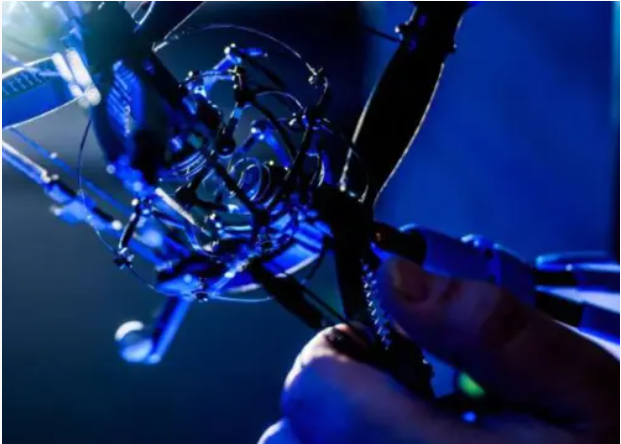 Source: Matthew Modoono/Northeastern University
The robot was designed to potentially offer safer, more flexible substitutes for conventional rigid robots in industrial settings, lowering the possibility of mishaps.
“It’s flexible, extendable and compliant like an elephant trunk or octopus tentacle, but can also apply torques like a traditional industrial robot,” the researchers explained.
To mimic the octopus-inspired robotic arm, the researchers developed mechanical units called Torsionally Rigid Universal Couplings (TRUNCs), which are units that can bend and extend, and stiffen when twisted, which allows them to efficiently transmit force.
The developers of the robotic arm explained that each TRUNC features a sphere with two poles, an equator and axial links that connect the poles. When twisting the poles relative to each other, stiffness increases, which offers structural support while also maintaining flexibility.
The team created two different TRUNC variations with various movement capabilities and demonstrated that they could be connected in series to create flexible shafts or nested to encourage rotational movement. By using a combination of both configurations, the team created a soft robotic arm and then trained a neural network to interpret its joint movements.
When trialed, the TRUNC arm was capable of shutting off a leaky valve, inserting and screwing a lightbulb into a socket, and securing motherboard bolts while simultaneously assisting a person.
The elephant-inspired robotic arm is detailed in the article, “Bridging hard and soft: Mechanical metamaterials enable rigid torque transmission in soft robots, which appears in the journal Science Robotics.
