
A team of engineers from the Massachusetts Institute of Technology (MIT), the Swiss Federal Institute of Technology of Lausanne (EPFL) and the University of Cincinnati has created a new soft magnetic hydrogel capable of being 3D-printed into microscopic structures.
According to its developers, the new gel enables individual components of one tiny robot to deform and move independently when exposed to an external magnet, unlike earlier magnetic materials that travel as a single unit.
 Source: Carlos Portela, et al.
One possible application for these magnetically controlled soft robots — or magno-bots — could be in healthcare where the robot collects tiny medical samples or delivers medicine into the body.
“We can now make a soft, intricate 3D architecture with components that can move and deform in complex ways within the same microscopic structure. For soft microscopic robotics, or stimuli-responsive matter, that could be a game-changing capability,” the team explained.
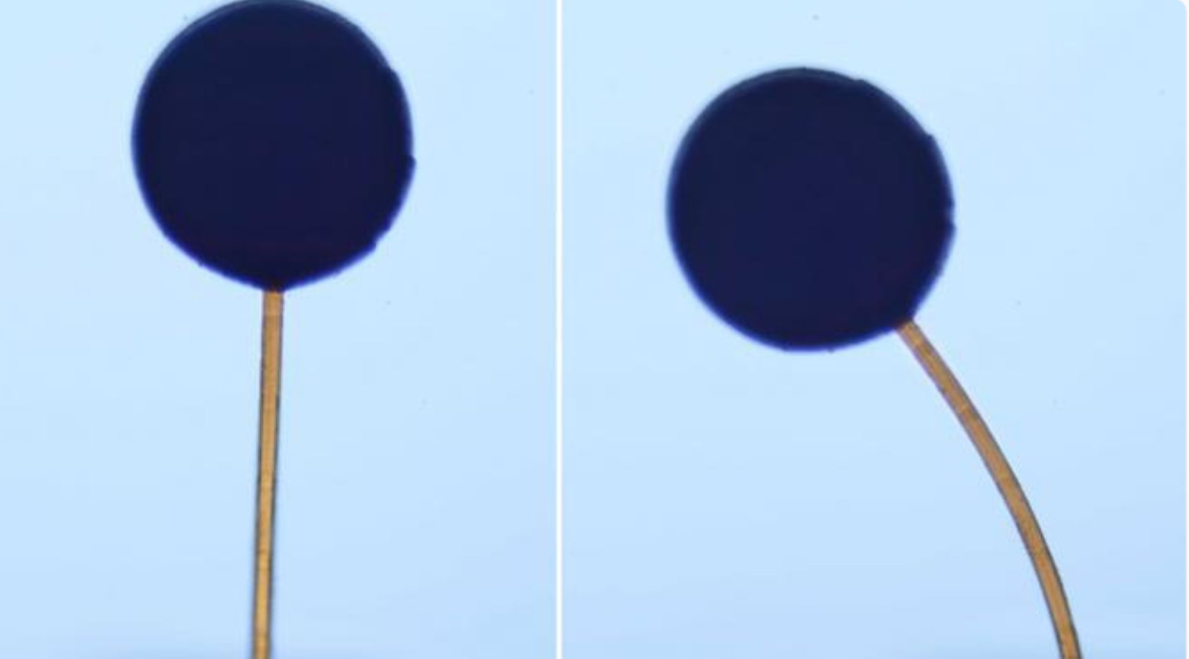
To demonstrate, the team created tiny 3D-printed “lollipops” composed of a magnetic gel, each of which is smaller than a grain of sand. When a magnet is waved near it, the “lollipops” can rapidly transform into robotic grippers.
To develop such magnetically responsive structures smaller than a millimeter, researchers typically rely on two-photon lithography, which is a high-resolution 3D printing technique that relies on lasers to solidify resin.
The team noted that the standard 3D printing of magnetic materials is complicated because magnetic nanoparticles — which are essentially tiny bits of metal — tend to scatter the laser light and clump together. Such interference tends to reduce the laser’s power and subsequently compromises the structural integrity of the print, thereby rendering it almost impossible to manufacture intricate, functional microdesigns.
As such, the team employed a “double-dip” fabrication process to overcome these printing obstacles, adding magnetic properties following the completion of 3D printing.
First, the team printed a clean polymer microstructure and then immersed it in successive chemical baths to grow iron-oxide nanoparticles within the gel.
Additionally, the gel’s density can be regulated by adjusting the laser power during the initial printing. Specifically, a tighter gel absorbs fewer ions, thus allowing for the precise tuning of the magnetism of individual parts within one microscopic robot.
During trials, the 3D-printed “lollipop” structures were magnetized to assorted levels. When a simple refrigerator magnet was exposed to these individual components, they reacted with different strengths, enabling the network of lollipops to synchronize their movements.
These synchronized movements mimicked the movement of gripping fingers, thereby proving these microscopic structures can operate as remotely controlled robotic tools.
Going forward the team envisions that these magnetically controlled micro-robots could be guided through the body to perform tasks like collecting tissue for biopsies. They also developed a tiny bistable device — essentially, a gel strip with microscopic magnetic “oars” — that can be switched on and off using an external magnet, potentially functioning as a miniature valve that controls fluid flow in medical applications.
The team’s work is detailed in the article “Magnetically responsive microprintable soft nanocomposites with tunable nanoparticle loading,” which appears in the journal Matter.
