
A team at the Italian Institute of Technology (IIT) has built an octopus-inspired soft robotic arm that is capable of sensing contact, estimating the intensity and direction of the applied force, and autonomously grasping objects, even in underwater settings.
Making this possible is that the robot’s soft manipulator’s suction cups feature tactile sensors that enable touch-based autonomous manipulation.
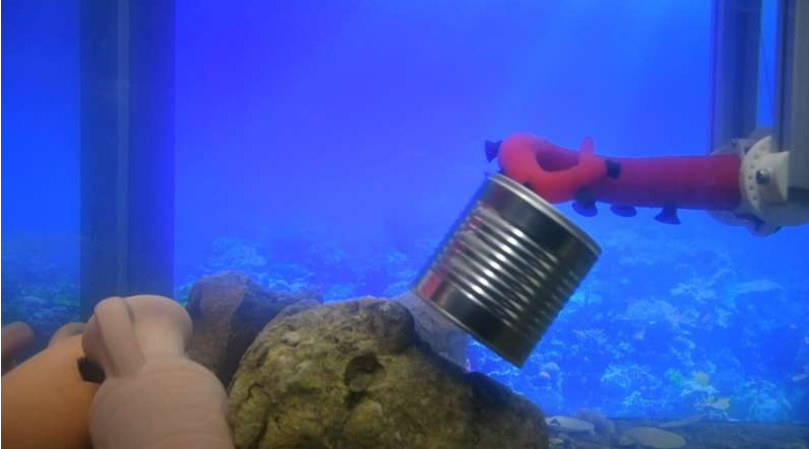 Source: IIT-Istituto Italiano di Tecnologia
Taking inspiration from the octopus, which is capable of manipulating objects with its flexible arms, sensitive suction cups and a distributed nervous system, the team built a prototype robotic arm outfitted with artificial silicone suction cups that feature mini optical sensors developed using mathematical models. As the suction cups encounter an object, structural deformation changes how light from internal LEDs is reflected, allowing the system to determine both the magnitude and direction of the applied force.
The data captured by the sensors is then processed by a control system that coordinates the suction cups and the arm’s movements, thus enabling the robot to grasp objects by bending, twisting and wrapping around them. As such, the system can detect very weak stimuli and operate both in air and underwater.
"By integrating sensors and signal processing directly into the suction cups, the arm reacts to contact in real time and precisely, without relying on centralized control. The result is a scalable and robust system designed to operate in complex environments, including underwater," the team added.
The team suggests that some possible applications for the robotic arm include handling fragile objects and biological systems in underwater environments and inspection and maintenance in hostile industrial and natural settings, for example.
An article detailing the work, “Peripheral control enabled by distributed sensing in an octopus-inspired soft robotic arm for autonomous underwater grasping,” appears in the journal Nature Machine Intelligence.
