
A team of scientists from the Technical University of Ostrava in the Czech Republic has developed microscopic robots that are capable of cleaning up microplastics from both soil and aquatic environments in the lab.
Across the globe, microplastics are a growing environmental threat because they can degrade soil, disrupt ecosystems and enter the food chain. Their tiny size also makes them extremely difficult to remove, particularly from soil, where they become trapped among minerals and organic matter.
The developers built the microscopic robots from layered MXene particles that attract and trap plastic. These magnetic nickel nanoparticles added to the material allowed rotating magnetic fields to propel and control the robots.
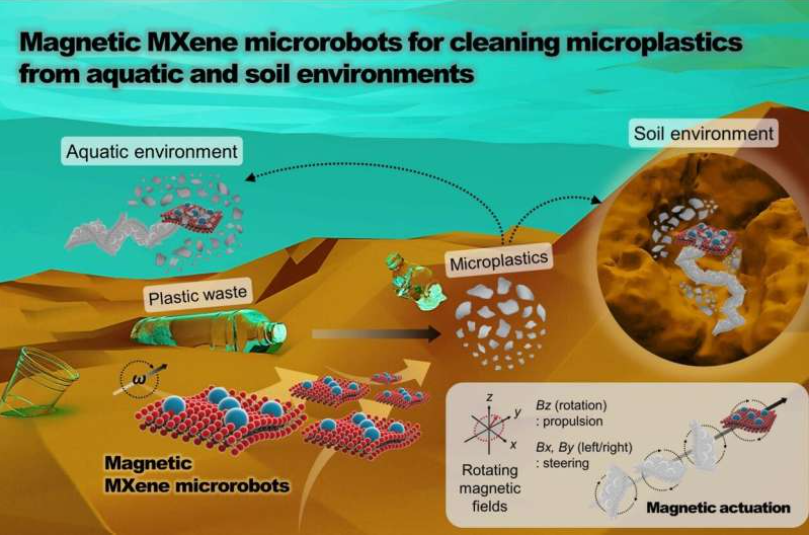 Source: NPG Asia Materials (2026). DOI: 10.1038/s41427-026-00670-7
In the lab, the team submerged swarms of the microscopic robots in water and soil samples contaminated with plastic. Meanwhile, the externally powered magnetic fields enabled the robots to spin through the liquid and squeeze through tiny water-filled gaps in the soil.
"In soil environments, the microrobots can navigate through water-permeated soil microenvironments, actively disrupt microplastic entrapment within soil matrices, and extract them," the team noted in its research paper.
Once in motion, the robots’ sticky surfaces encountered microplastics, binding to them and subsequently dragging them along. The team then successfully pulled the microscopic robots and their trapped microplastics from the soil samples using a magnet.
Specifically, the magnetized microscopic robots removed up to 94% of polystyrene and 89% of polyethylene terephthalate (PET) microplastics from water within an hour, while removing 81% and 72%, respectively, from soil. Further, the active magnetic motion outperformed passive MXene adsorption, although real-world trials are still necessary to determine the effectiveness and potential risks such as metal-ion leaching and incomplete robot retrieval.
An article detailing the microscopic robots, “Magnetic MXene-based microrobots for soil microplastics removal,” appears in the journal NPG Asia Materials.
