
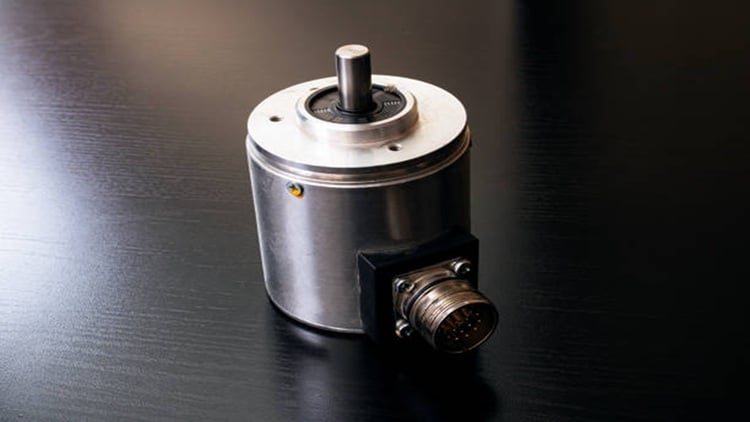
Encoders are crucial for motion control in robotics as they provide accurate and precise information about parameters such as speed, position and angle. Over the last decade, the robotics industry has expanded as several new industries are automating processes. Robots' automation environments often have difficult technical requirements because they are frequently used to do dangerous or repetitive tasks that people can't do.
Motion-based encoders
Rotary encoders
Encoders can be classified based on the motion that they can measure. Rotary encoders are used to measure parameters such as angle, location or speed of rotation. Based on their structure, they can be further categorized into mechanical and optical rotary encoders. Mechanical rotary encoders utilize cams, gears and similar physical parts to measure rotations and generate electrical signals. Optical rotary encoders are based on optical principles and use sensors to detect rotational motion passing through a disk or grating. They are preferred for applications that need exact measurements as they can provide high resolution and accuracy.
Linear encoders
Linear encoders are utilized to measure linear motion, such as position and displacement. Similar to the rotary encoders, they can also be grouped into optical linear encoders and mechanical linear encoders. In mechanical linear encoders, touch sensors are used that work with a linear scale to find positional signals. These encoders are inexpensive, easier to use and are preferred for applications where high accuracy isn't needed. Optical linear encoders use light to scan a grating or scale in order to get positional signals. Because they have higher resolution and accuracy, these encoders are often used in applications that need high precision, such as robotics and CNC machines.
Encoder categories based on output signal
Incremental and absolute encoders
Another important way to group encoders is by how they send out information. When an incremental encoder moves, it sends out a series of electrical pulses. A known starting point is used as a reference to count pulses and help the system figure out where it is. They are cheap, simple and functional so long as power is on; if one wants to avoid losing position data when the power goes off, one should have a backup battery. In contrast, absolute encoders assign a unique digital code to each position, guaranteeing that the precise location can be always known, regardless of the availability of power. Despite being more complex and costly, they are chosen for use where data loss cannot be tolerated.
Encoder forms based on sensors
Optical and magnetic encoders
Another way to categorize encoders is by the kind of motion sensor they use. In optical encoders, a light source is used in conjunction with a patterned disk. When the disk rotates, it obstructs the light, which in turn produces signals. These encoders have exceptional accuracy and resolution, rendering them appropriate for precision applications; however, they are susceptible to dust and pollutants. Magnetic encoders utilize magnetic fields and sensors to detect motion, rendering them more resilient and suitable for operation in adverse situations characterized by vibration, wetness or filth. Although marginally less accurate than optical encoders, they exhibit considerable reliability in industrial environments. Alternative varieties, including capacitive and inductive encoders, offer distinct sensing techniques that optimize cost, durability and performance based on the specific application.
Applications
Encoders are essential in robotics as they deliver continuous feedback, facilitating precise and intelligent motion control. The following are some of its major applications:
Manipulators and robotic arms
o Determining exact placement requires measuring joint angles.
o Make it possible to carry out repetitive activities like welding, assembling and pick-and-place.
Automaton on wheels
o Wheels utilize them to determine the speed and distance traveled.
o Aid in navigating by means of odometry.
o Assist with tracking and route planning.
Servo motor control
o Give closed-loop control feedback in real time.
o Make sure that moving forward, stopping and positioning are all done smoothly.
o Make robotic movements more precise and efficient.
Coordination among multiple axes
o Coordinate the motion of numerous joints in intricate robots.
o Make sure that movement is consistent and harmonized along all dimensions.
Advanced robotics
o Robots used in surgery to facilitate exact motions
o Robots that can navigate and create maps on their own
o Robots used in industry for jobs requiring precision and speed
Conclusion
Encoders let robots understand and regulate their movement. Advanced automation would not be possible without encoders as it allows robots to be precise, reliable and intelligent. In addition to improving their ability to measure motion, encoders of the future will likely shrink in size, gain intelligence and find greater use in intelligent robotic systems. Encoders, which started out as basic feedback devices, will develop into crucial tools for intelligent motion control as robotics advances toward autonomy and applications driven by accuracy.
