
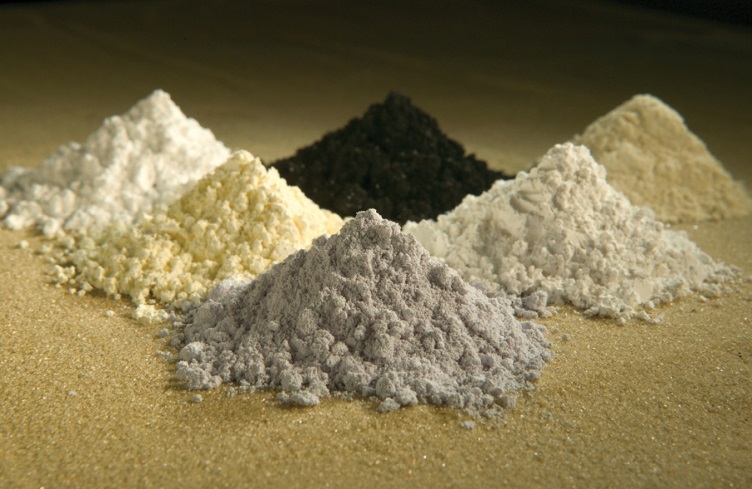
In April 2025, China imposed even further export restrictions on seven additional medium and heavy rare Earth elements — samarium, gadolinium, terbium, dysprosium, lutetium, scandium and yttrium — in response to the Trump Administration’s tariffs on the country.
These elements were added to the already restricted sale of other rare Earth elements from 2024 to the U.S. including gallium, germanium and antimony.
A month later, these seven Earth elements are soaring to double or in some cases triple in price. As a result, it is very likely prices for semiconductors, electric vehicles (EVs), renewable energy and storage applications are also going to rise.
At CES 2025, Electronics360 talked with Duncan Stewart, research director in Canada for market research firm Deloitte, where he prognosticated about further raw material export restrictions after the initial ban in 2024.
“It is highly likely things will get worse as export restrictions grow in 2025 as the trade war continues,” Stewart said.
Stewart suggested there were three ways to combat China’s raw material ban:
- Recycling
- Finding alternative sources
- National reserve build-up
However, this is going to take significant time.
Significant dependencies
The U.S. has substantial dependencies on elements like germanium and gallium that are used in the manufacturing of semiconductors. These latest seven Earth elements are also used in semiconductor manufacturing as well as in the rare Earth magnets that China supplies 90% of the world’s supply.
These magnets are necessary for electric motors that are used in applications like EVs, drones, robots, missiles and spacecraft.
“The semiconductor industry is particularly sensitive to supply shortages,” said Adam Carter, CEO of OpenLight, a custom PASIC design maker. “If shortages of critical materials arise, they will likely bring policy makers to the negotiating table and rethink the restrictions. While solutions may eventually emerge, the timeline remains uncertain.”
While other countries have some mining capacity for these elements, according to Project Blue, China accounts for 59.2% of refined germanium output and 98.8% of refined gallium production. Additionally, the U.S. received 70% of rare Earth imports between 2020 and 2023 from China, according to Statista.
Finding alternatives will take time and effort.
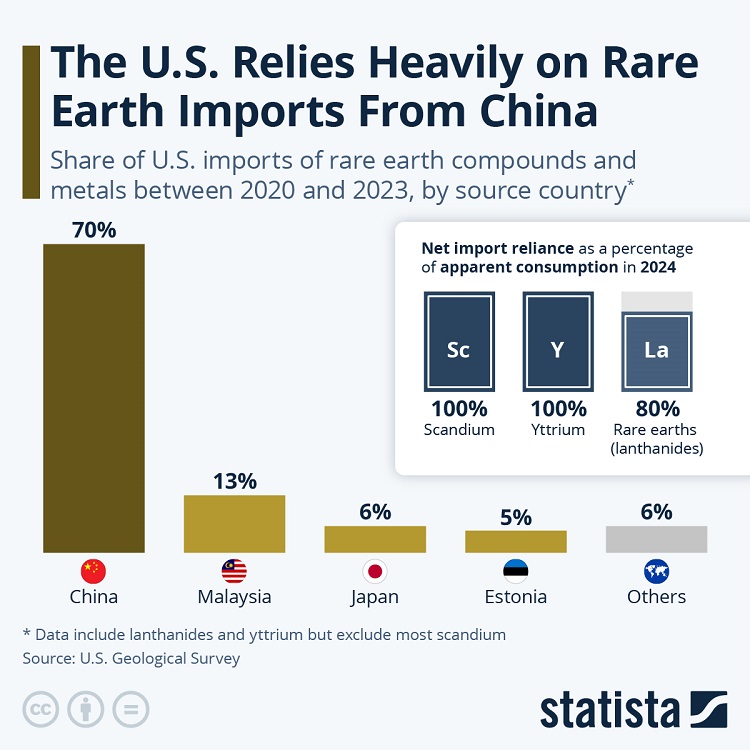 Source: Statista
Limited alternatives
Carter said there are no direct one-to-one replacements for gallium and germanium but there are alternatives like silicon and indium as well as advanced materials like carbon nanotubes. However, these alternatives come with limitations in terms of performance and cost, specifically for renewables and EVs.
“The impact of China's export restrictions will likely vary depending on the specific application and the availability of alternative materials and suppliers but could be significant,” Carter said.
The U.S. just signed an agreement with Ukraine to provide 22 rare Earth elements including lithium, graphite, manganese, zirconium, iron and various non-ferrous metals. However, not all of these will work as alternatives to the rare Earths coming from China and it is highly unlikely the U.S. will see a quick payback.
The Trump Administration is also expected to sign a rare Earth element deal with Saudi Arabia this month that will likely include some metals used in these sectors. But again, it will take time to see the materials come into the country.
Recycling slowly
One suggested method of garnering new raw materials is through recycling. Unfortunately, while projects and some vendors are actively working on systems to recycle raw materials such as gallium and germanium and other rare Earth elements, they are in the nascent stages.
The EcoGaIN research project developed a process for gallium-containing waste materials to recycle nearly 100% of gallium to be recovery and re-used.
Taiwan is emerging as a major electronics recycler, reclaiming rare Earth elements such as gallium from electronic waste. Solar Applied Materials Technology Corp. is developing in-house recycling processes to extract gallium and indium from electronic waste.
There is also a domestic U.S. program from the Defense Logistics Agency (DLA) to recycle optical-grade germanium used in defense and aerospace
A Defense Logistics Agency program for recycling optical-grade germanium used in military weapons systems and night vision equipment has led to new capability in the U.S. defense industrial base. The program is from a small team at Pennsylvania’s Tobyhanna Army Depot. This program is small but is looking to expand access to scrap germanium for re-use.
Shortages inbound
With restrictions placed on rare Earth elements from China, companies have already sounded alarms that the volume has dropped by about half since the controls of gallium and germanium were implemented. If the restrictions continue, reserves that were built up when the restrictions were first imposed could be depleted, leading to shortages.
China’s dominance in rare Earth materials is due to a competitive edge thanks to its efficient, vertically integrated supply chain for mining, processing and refining.
And as this is unlikely to be the last round of rare Earth element restrictions, the supply chain will need to adapt to the new reality. According to Tom’s Hardware, that means global industries will need to source building their own supply of these rare Earth elements with investment in locations outside of China.
But in the meantime, shortages are inbound.
What it means
To put it simply, prices are rising on everything that uses these rare Earth elements.
Tariffs, restrictions on semiconductors globally, restrictions on rare Earth elements and geopolitical instability are likely to disrupt the supply chain, leading to increased production costs for many industries.
“This could ultimately translate to higher prices for consumers on a range of products, from smartphones and computers to automobiles and household appliances,” Carter said.
Additionally, those looking to buy a new EV or install solar panels will likely look at an increase in price. The defense and aerospace industry will also likely have to pay more for semiconductors, magnets and other parts as these conditions coalesce.
