
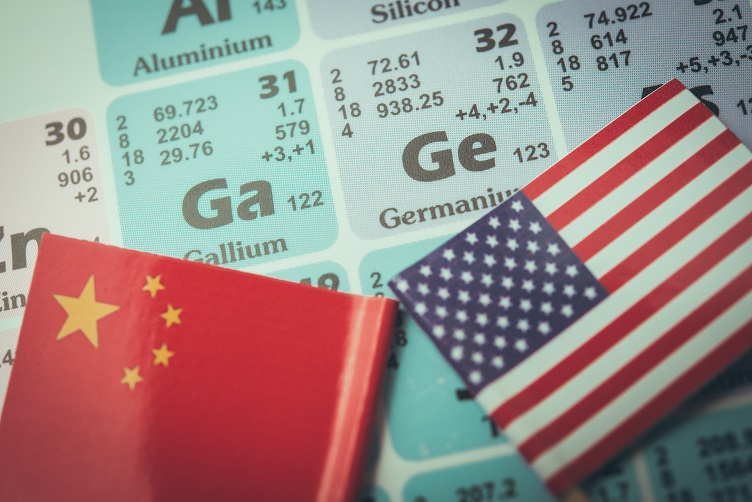
In July, the U.S. made a deal with China that saw electronic design automation (EDA) tools opened again for Chinese firms to purchase and use in exchange for certain rare Earth elements.
This tit-for-tat technology-for-mineral exchange is likely the first of many in the coming months and years, according to several experts.
China lacks the ability, for now, to garner the semiconductor equipment and tools needed to further its technological and manufacturing growth. The U.S., for now, has limited ways of sourcing rare Earth elements outside of China.
The deal will allow EDA firms — like Synopsys, Siemens EDA and Cadence — to resume selling and sending these tools to China. In exchange, China curbed some export controls on rare Earth materials like antimony, gallium and germanium.
Deals coming
There is a long history of exchanging strategic resources, technology and goods between countries to secure what is needed for growth. China’s infrastructure-for-resources deals in Africa is just one notable example of previous deals.
These agreements are usually driven by necessity or by a geopolitical strategy. What’s happening with the China and U.S. trade/technology war fits well into this well-established pattern, said Rob Picken, SVP of Digital Transformation at Sourceability.
“Given the dynamic nature of trade and export controls, especially under the current administration, it’s likely we’ll see more of these reciprocal exchanges in the future, particularly involving rare earths and semiconductor equipment,” Picken said. “However, such deals are always subject to change. Companies should remain agile, closely monitoring policy developments and preparing to adjust sourcing and supply chain strategies as needed.”
Phil Solis, research director for client processors and connectivity at market research firm International Data Corp. (IDC), agrees that more deals are coming despite the random nature of what’s happening with tariffs and export restrictions.
“You could look at this myopically as this is what U.S. is doing to China for whatever reasons, but it also hurts other companies,” Solis said. “It hurts U.S. companies that want to sell products to China. It hurts European companies that want to sell equipment to China. It is more than just what is happening between the U.S. and China.”
According to Chris Mitchell, VP of global government relations at the Global Electronic Association, more deals are likely to come specifically for:
- Advanced packaging equipment
- Semiconductor manufacturing equipment
- Design software
In exchange the U.S. is likely to get materials like tantalum, palladium and more, Mitchell added.
“I think the U.S. needs to be sure it is receiving commensurate value in return for any of these deals,” Mitchell cautioned. “Conversely, we must be sure that we don’t become more vulnerable to China withholding rare earths at some point in the future. If other countries can expand the electronics industry supply chain to other countries, this will have global benefits.”
Rare Earth ramp up
China is, far and away, the largest supplier of rare Earth materials globally. That means that the semiconductor industry — and by extension the automotive, data server, AI, industrial, robotics and automation sectors — is beholden to getting these materials from the country.
Because of this, the supply chain is potentially at risk from a lack of elements, especially as China and the U.S. continue a trade and technological war.
Not surprisingly, this is leading to other countries ramping up their abilities to refine, separate, sort and purify rare Earth elements.
“We are seeing a larger focus on spreading out geopolitical risks,” Solis said. “This is happening for many reasons. It could be politics; it could be trade policies; or with the ports being shut down during the pandemic. Or it could be wars. There are many reasons why a supply chain could be disrupted and having a supply that has more geodiversity is becoming critical.”
The countries expanding rare Earth material mining and refining include:
- Thailand
- Myanmar
- Brazil
- Russia
- India
- Vietnam
- Greenland
“We are already seeing increased interest and investment in rare earth mining and processing outside of China, as companies and governments look to diversify supply chains and reduce over-reliance on a single region,” Picken said. “However, establishing stable supply chains for these minerals in new regions is a lengthy process, often taking several years.”
Picken said progress is being made in Vietnam, India and Brazil, but in the near-term China will be the main source.
“Ultimately, the threat of tariffs and export controls is likely to accelerate diversification, but meaningful change will require sustained investment and, in many cases, government support to make alternative sources viable,” Picken said.
