
Once upon a time, diagnosing and repairing car trouble and keeping cars in good working order was the purview of automotive mechanics. These experts learned the ins and outs of internal and external car systems, and practiced and perfected techniques that could be applied across a wide range of makes and models.
The best mechanics could even tell you, based on maintenance and repair history, current gauge readings, and their own personal intuition about the sound of an engine, how a given car “feels” — whether it was in tip-top shape, or feeling “sick” and in need of treatment (or at least a good rest).
But today, vehicles are increasingly telling the driver how they feel and providing actionable insights on how to keep things running smoothly.
Automotive sensors' role
That's where automotive sensors come in. When combined with wiring for connectivity, they can be thought of like a human nervous system. Status changes in properties like pressure, temperature and motion are detected by sensors in the same way that our eyes, skin and ears pick up external cues; the system continuously gathers real-time data from all over the vehicle and sends it to a “brain,” in this case an electronic control unit (ECU), and the brain responds by making necessary adjustments.
Andrew Klein, co-founder and CEO of Brighter Signals, an Amsterdam, Netherlands-based startup that develops fabric-based tactile sensors designed to impart human-like touch perception to machines and objects, is no stranger to this dynamic.
Klein spoke with GlobalSpec recently to discuss the modern design of a vehicular occupancy classification system. As he put it, the system sends “a series of messages to the airbag managing system that starts with "‘Is there a person in the car, in the seat? Are they a child? Are they an adult? Is it an object, like a suitcase?’”
 Andrew Klein is co-founder and CEO of Brighter Signals, which develops fabric-based tactile sensors. Source: Brighter Signals Once that classification is established, Klein continued, “the system is constantly monitoring for an event that would indicate that that person was no longer in the seat. And while they're in the state of being in the seat, the system is regulating or monitoring whether they are in or out of position, all for the purposes of essentially instructing the airbag management system to deploy or repress the airbag in the event of a crash.”
That’s a far cry from a simple assessment of whether or not there’s weight on the seat, and it’s an example of the sort of granular intel that’s key to the shift toward “full cabin intelligence” — a goal that was top of the list of six trends defining the future of automotive sensing identified during a June 2026 press briefing presented in Detroit, Michigan, at an event co-hosted by AutoSens USA and InCabin USA.
Tactile sensor based
Klein noted that the technology behind his company’s tactile sensors is based on two related inventions by Brighter Signals co-founder and CTO Edward Shim.
The first is a resistive sensor that represents a new milestone for measuring pressure, not to mention a unique origin story. While recovering in a hospital bed from a punctured lung, Shim started thinking about how a smart mattress or a wearable smart fabric might be used to measure vital signs. Sensors composed of two layers of fully conductive material were already on the scene, and they provided a rudimentary way of measuring weight. Pushing on the top layer makes current flow to the bottom layer, so the amount of voltage produced corresponds to the amount of pressure applied. But this is a binary “all-or-nothing” proposition, as Klein explained: Either the layers are all touching, or they’re not.
Shim’s variation added a semiconductive layer, along with geometric pattern cuts to create “bridges” between the two layers — essentially creating a collection of individual sensors with multiple paths for electrons to flow through. Pressing down on the top layer diffuses the electron flow, slowing it down and yielding a more precise measurement.
“You can actually use it like a scale to measure the pressure or the force,” Klein said.
Proximity sensor built in
The second invention is a capacitive proximity sensor built from the same fabrics, placed side by side. This creates an electrical field across the surfaces; when a human body comes in contact, it will change some capacitance and produce a measurable delta that can be translated into a precise read on a seat occupant’s position.
Unlike a traditional capacitive sensor constructed from layers placed on top of one another, Shim’s side-by-side approach extends the range. The result is a capacitive sensor that, according to Klein, can be deployed on a dashboard while remaining light, flexible and affordable.
The new generation of sensors is being met with interest by automotive OEMs.
“There's a generation of sensors that have been in cars for about 25 years,” Klein noted, referencing familiar devices such as seatbelt reminders and airbag systems. “The main problem with those sensors [is that] they don't actually get a granular readout on weight. So they tell you someone's on the seat … it can tell you the difference between a very, very light object and a very heavy person, but they don't actually measure weight accurately.”
Moreover, those traditional sensors are made from hard and rough materials. By contrast, Klein said, fabric-based sensors “are very light and flexible, so they work just much more accurately in the real world, where things are not hard and flat.”
The newer sensors may also ensure a level of future-proofing as regulatory requirements and safety standards evolve to keep pace with emerging sensor capabilities, as is already evident in the latest safety scoring system from Euro NCAP.
Automotive sensor fusion
Sensor fusion — combining data from multiple sensors to generate deeper actionable insights — is another area where Klein sees an opening for his company’s product. To perform occupancy classification, he said, the industry is looking at a fusion of cameras — which will be omnipresent in cars — and other technologies; the assumption has been that radar will fill the niche.
“But neither the camera nor the radar can actually give you weight,” Klein said. “And [they] can't give you the micro-movements of the person moving around … both camera and radar are very high power; they need a lot of compute to process the images. They need power to run, whereas we have the benefit of being very, very low power, and real time. … I think what's happening this year is that radar is losing in the cabin in favor of cameras and sensors that are capable of doing the job.”
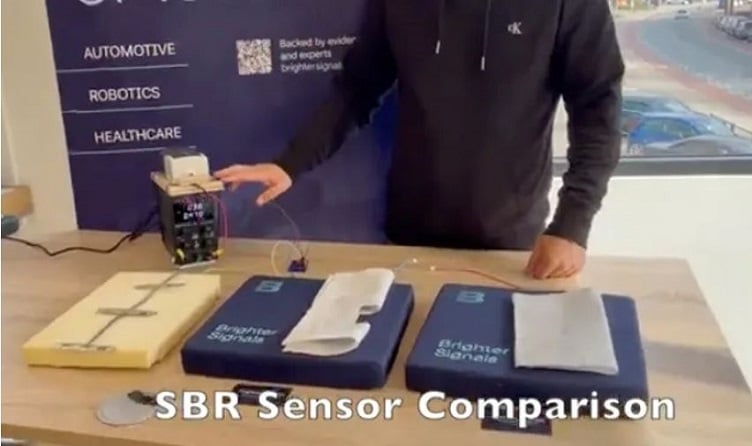
In June 2026, Brighter Signals introduced a next-generation seatbelt reminder (SBR) sensor that uses richer weight and weight-distribution data to overcome the limits of traditional binary presence detectors.
Klein described this as a “dumbed-down” version of a full occupancy classification system: It doesn’t need a software algorithm to capture data to make a more accurate belted/unbelted decision. As a result, he said, it can provide — at a cost competitive with incumbent binary sensors — reliable detection of small occupants, even when they aren’t seated squarely. According to Klein, this is a well-known coverage gap and safety shortfall in legacy SBR sensors.
On the horizon is software optimization, which Klein described as an opportunity for neural network development.
“If you think about the pattern recognition, it's not just the weight distribution, but the density of the cushion, the hammock effect underneath all these seats … that basically causes some drift in the measurements. You sort of sink into the seat, and then the sensor values have to be adjusted by the algorithm,” Klein explained. “The AI that's coming [will] be able to do that way better than we do it. … if you think of all the AI inside the automobile, it needs data, and we're providing a source of data that hasn't previously been available. What to do with that data also will be an area of ripe, new innovation.”
