
Researchers from Penn State developed a way to print sensors directly on human skin without heat.
In the past, printing directly on skin has been hindered by the bonding process for metallic components, called sintering. Sintering typically needs temperatures around 572° F to bond silver nanoparticles, which is entirely too hot for skin.
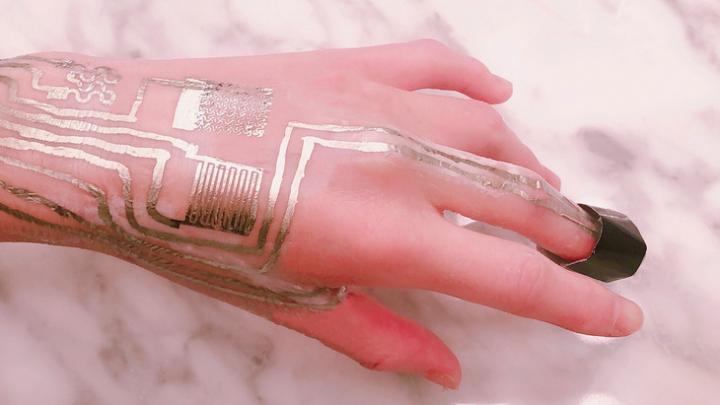 With a novel layer to help the metallic components of the sensor bond, an international team of researchers printed sensors directly on human skin. Source: Ling Zhang, Penn State/Cheng Lab and Harbin Institute of Technology
To overcome this issue, the team created a sintering aid layer that would enable sintering at lower temperatures and protect the skin. They added a nanoparticle that allows silver particles to be printed at a lower temperature of 212° F. While this temperature allows the particles to be printed on clothing and paper but is still too hot to be used on skin. So the team adjusted the formula of the aid layer and changed the printing layer, which allowed sintering to happen at room temperature.
The room temperature sintering aid layer is made of polyvinyl alcohol paste, which is often used in peelable face masks, and calcium carbonate, which is found in eggshells. This layer reduces the printing surface roughness and allows the layer of metal patterns to bend and fold while maintaining their electromechanical capabilities.
Once the sensor is printed, an air blower is used to remove the water in the ink. The wearable sensors can precisely and continuously capture temperature, humidity and blood oxygen levels, as well as heart performance signals. They linked the on-body sensors into the network with wireless transmission capabilities to monitor a combination of signals.
The team says their process and the resulting wearable is environmentally friendly and recyclable. It works in water for a few days, but a hot shower easily removes it but does not damage the device.
A paper on this research was published in ACS Applied Materials Interfaces.
