
The potential to harvest energy from graphene was examined using a graphene membrane coupled to a circuit with diodes featuring nonlinear current-voltage characteristics. An international research team tested this setup to explore conversion of the thermal, or Brownian, motion of graphene into electrical current.
Previous research demonstrated that and found that at room temperature the thermal motion of graphene does induce an AC at room temperature. The current study published in Physical Review E evaluated a circuit with two diodes for converting AC into DC. Fluctuating freestanding graphene and a scanning tunnel microscope tip 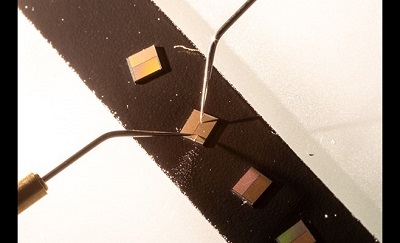 Testing a graphene chip with scanning tunnel microscopy tips. Source: University of Arkansasfunctioned as moving plates of a variable capacitor coupled to diodes and a battery that supplies DC voltage. The graphene sheet was rippled with curvature fluctuating between concave and convex as it exchanges energy with the circuit and the thermal bath. With the diodes in opposition allowing the current to flow both ways, they provide separate paths through the circuit, producing a pulsing DC current that performs work on a load resistor. The relatively slow motion of graphene induced current in the circuit at low frequencies, which is where electronics function most efficiently.
Researchers from the University of Arkansas, the University of Pennsylvania, Universidad Carlos III de Madrid (Spain), Universidad de Granada (Spain) and New York University demonstrated that continuous thermal power can be supplied by a Brownian particle at a single temperature while in thermodynamic equilibrium, provided the same amount of power is continuously dissipated in a resistor. The next goal is to determine if the DC current can be stored in a capacitor for later use and serve as a low-power battery replacement.
