
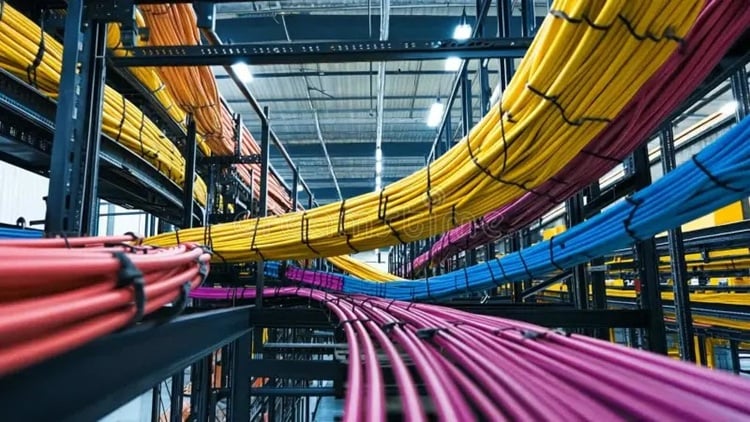
A complete rethinking of traditional data center design, including cable components, is required to deploy future artificial intelligence (AI)-driven applications. Servers, storage, networking, power distribution units, cooling systems, security protocols and ancillary components like racks and fire suppression systems were all part of the traditional data center architecture, which aimed for stability and operational continuity.
These long-established practices have been questioned by energy and computationally intensive AI applications. Powering denser racks with more power, maintaining constant performance under rising loads and adding capacity at unprecedented speeds are all challenges for modern data centers. From the power grid connection to the server cabinet, these demands are putting a heavy burden on the physical infrastructure.
Need for "high-density" solutions in data centers
The transition from 400G to 800G, and now progressing toward 1.6T, has resulted in a dramatic increase in optical module bandwidth; nonetheless, interconnect density and spatial efficiency have emerged as significant constraints. AI clusters are establishing extensive linkages among GPUs, storage and AI workloads, leading to intricate fiber management, heightened operational challenges and elevated energy consumption.
Managing power and cooling requirements
The growing need for both power and cooling are a major cause for alarm. Modern designs call for 70 A, 100 A or even 200 A, often within the same physical rack dimensions, while older rack constructions required 16 A or 32 A. New difficulties in deployment and maintenance are brought about by the large increases, which lead to more heat and the necessity of thicker, less flexible power cable.
It is a major technical accomplishment to effectively dissipate heat from ever-increasingly compact configurations. Full-system immersion and liquid cooling, two examples of next-generation cooling technologies, are moving from being nice-to-haves to necessities. There is a possibility of inefficiency or danger at every connecting point and along every wire run. Power distribution systems that are too old or poorly optimized lead operators to lose energy, generate heat or experience outages.
How to design data center wiring
Numerous factors must be considered regarding cabling components. Should one utilize copper or fiber cabling? Is patching more advantageous than switching? Inquiries on server specifications, port density and cabling amount should be made well in advance to facilitate optimal planning. This is essential. Utilizing data center infrastructure management software may enhance real-time visibility for each cabinet.
Record all new patch cabling installations
Documenting patch cabling may appear trivial, yet it is essential. In the absence of effective documentation, obstacles may arise in installing or maintaining new equipment, as well as in diagnosing connectivity issues.
Determine the required length of cable
Subsequently, one must determine the required length of cable. Precise dimensions prevent a data center from becoming cluttered with excess cabling. Additionally, designers can minimize waste, hence lowering expenses.
Manually measuring cables with a tape might be laborious; therefore, utilize software to automate this task. Efficient instruments provide the rapid and precise measurement of both horizontal and vertical lengths, ensuring optimal cabling for a data center. No interruptions or revisions. Consider that this also aids in eliminating copper waste, so enhancing the eco-friendliness of the facility.
Compile precise guidelines for cable installation
Generally, one team is responsible for the design of the data center, while another team manages the installation. Inadequate directives on the construction sheet from the design team may result in erroneous connections and substandard installations. Software facilitates the generation of precise work orders and the documentation of exact instructions. Additionally, it would be beneficial to print the work orders for the installation team. Consider establishing a mechanism for the build team to address any inquiries.
Verify the connections
During the installation of cable for a data center, the distances between the termination and initiation points, as well as the quantity of cables, should be primary considerations. Nonetheless, the compatibility of physical connectors is as essential.
Before provisioning new equipment to the rack, verify that the patch panel or switch possesses appropriate ports. Software will assist in excluding cabinets without sufficient compatible connectors from the design process, thereby significantly enhancing efficiency and productivity.
Monitor connectivity capability
Currently, numerous firms employ big data to enhance decision-making regarding data center management. However, it is essential to identify the connectivity indicators that require monitoring. Legacy tools can provide valuable insights into data, while the extent and type of cabling project will determine the chosen approach.
Conclusion
Information technology vendors, utility companies, cloud service providers, government agencies and lawmakers must work together extensively to modernize data center infrastructure. While AI has opened up new opportunities, it has also changed hidden requirements. A bigger, smarter, quicker and more ecologically friendly data center infrastructure is urgently required. In the race to fulfill exponential demand, every square foot of connectivity is now important.
