
Trinamic Motion Control GmbH & Co. has unveiled the TMC4671+TMC6100-TOSV-REF design board, a brushless DC (BLDC) servo driver capable of 12 V to 36 V with up to 6 A RMS to accommodate medical ventilator and respiratory system design. To shorten design cycles, the open-source module features a session border controller (SBC) connector in Raspberry Pi style and space for a pressure sensor add-on board.
Medical ventilator design must deploy sensor technology for monitoring and reacting to changes in pressure, flow, volume, respiration rate and other parameters. For this reason, the reference design board includes a 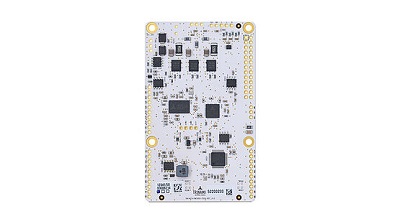 Source: Trinamic Motion Control GmbH & Co.Hall sensor interface and connectors for an optional pressure sensor add-on board. As a result, important pressure data can be directly visualized on a Raspberry Pi with touch screen using the free firmware developed by Trinamic for the reference design board.
“Our goal with this reference design is to show engineers how medical ventilators can be build using readily-available components, bypassing increased lead-times of traditional components during the COVID-19 crisis,” explains Michael Randt, founder of Trinamic. “Right from the start, we decided to use a high-RPM turbine motor based on a BLDC motor. Together with pressure and volume flow sensors, the dynamically controlled motor enables both pressure-controlled and flow-controlled ventilation modes. In line with the Trinamic Open-Source Ventilator (TOSV) project, which led to this reference design, both hardware and software are open-source.”
Trinamic’s previous experience with controlling CPAP device turbines showed that providing fast and dynamic control of low-induction BLDC motors can be exceptionally challenging. It requires careful consideration of the trade-off between high switching frequency and current ripples, and their consequent switching and stator losses, respectively.
Thanks to the embedded TMC4671 servo controller IC, the module generates a pulse-width modulation frequency and a current controller clock of 100 kHz independent of the microcontroller. This approach reduces the system’s current consumption by up to 15%, compared with a frequency of 25 kHz, without compromising performance.
