
To help satisfy the global need for medical equipment during the COVID-19 pandemic, an efficient emergency ventilator concept system incorporating electric linear actuators has been designed by engineers from Minnesota-based Tolomatic.
The prototypes automate a non-invasive, positive-pressure resuscitator, bag valve mask or artificial manual 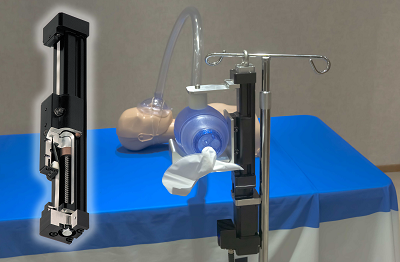 An electric linear actuator automates a positive-pressure resuscitator. Source: Tolomaticbreathing unit (Ambu). Currently the bag must be manually squeezed to provide airflow, which is not a viable process for long-term care. Automation with electric linear actuators can ensure that patients receive sufficient air supply for days or weeks.
Screw-driven linear actuators convert rotary power from a servo motor into linear motion, providing consistent operation and enabling the system to control the velocity, the acceleration and the distance of any move at any point in time. Such controlled motion allows for a more continuous volume of air per compression cycle and a more typical breathing cycle.
Inclusion of linear actuator systems in the ventilator can change the frequency and volume of induced respirations, which is not possible with fixed displacement rotary devices. The total control of motion from a linear electric actuator allows for much more flexible air flow that could now be modified for a patient’s age, size or current needs.
Key components of the re-engineered emergency ventilator include medically approved Ambu bags, the Tolomatic linear actuator, servo motor and drive, a simple control solution, rod-end puck for bag compression and a box for holding the manual resuscitator and mounting the actuator.
Learn more about linear motion control.
