
Researchers from the University of Barcelona, Institut d'Investigacions Biomèdiques August Pi i Sunyer and Virtual Bodyworks determined individuals give themselves effective personal advice if placed in a VR environment with a therapist that they also embody. 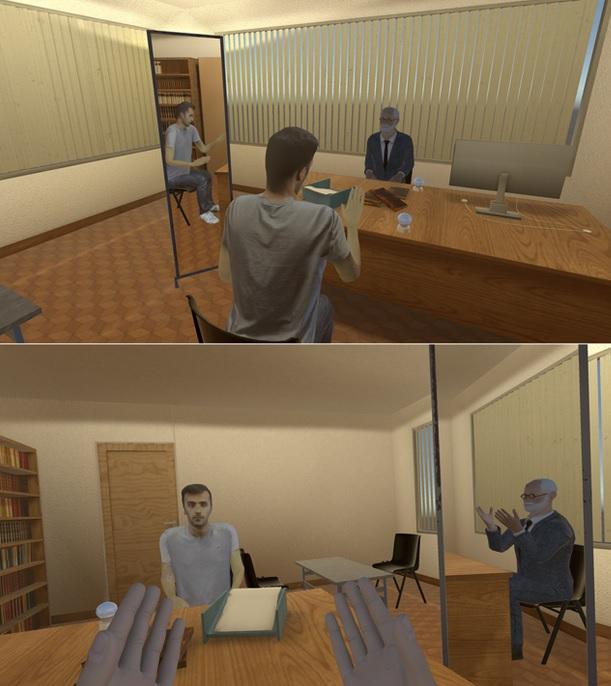 Researchers believe that this method could be a useful tool for clinicians. (Source: Scientific Reports, Nature Publishing Group)
The research team conducted the study by digitally scanning the subject and creating a VR avatar with the same appearance. Prior to the experiment, the subjects were also guided by a professional psychologist to facilitate therapeutic communication.
Subjects were then split into two groups. Group two was the control, where subjects would have a brief discussion with a VR Sigmund Freud, who offered preprogrammed advice.
Meanwhile, group one also discussed their personal problems with VR Freud, but were able to embody VR Freud as well. They gave their own avatar advice, however with a disguised voice. The conversation continued and subjects switched roles at will.
During past studies, researchers have observed subjects' perception, attitudes and behaviors change when embodying the VR avatar of a different person. This is called body swapping. In combination with disguised voice, group one subjects felt as though the conversation was between two separate people, instead of one person playing both roles.
A week after the experiment, 80% of the group one participants reported a change with their problem, while only 50% of group two reported feeling a change.
The results suggest that having a VR conversation with oneself using body swapping can improve a person’s mood and outlook. The participant’s pre-study meeting with the clinical psychologist may have skewed study results, so the team is planning an additional study to determine this.
The study was published in Scientific Reports.
