
Sponsored Content
Consumer Electronics
Improving measurement sensitivity for nanoscale device characterization
05 November 2026
Traditional materials-based semiconductor devices continue to shrink and operate at ever-lower signal levels. To pack more processing power into ICs, manufacturers have continually been reducing the feature size of the devices. As part of this scaling evolution, each successive generation of devices must be characterized with reduced voltage, current and power levels because ever-smaller new devices operate at correspondingly lower signal levels. The future adoption of emerging nanoscale semiconductor materials and devices will only accelerate these low-level signal trends.
For the engineer tasked with characterizing, validating and qualifying such devices, testing these structures with conventional instrumentation can be challenging. This is due to the devices often requiring sourcing and measuring at extremely low levels. Increasingly, background electrical ambient and test-setup-induced noise can be on par with — and often greater than — the signals of interest.
Complicating matters further, certain nanoscale materials, such as graphene, 2D transition metal dichalcogenides, nanowires and quantum heterostructures, operate at power levels much lower than the Group III and Group IV semiconductor devices traditionally studied. As device dimensions shrink and signal levels decrease, engineers are increasingly seeking ways to improve signal-to-noise ratio and measurement sensitivity when characterizing nanoscale devices.
A measurement architecture for nanoscale device characterization
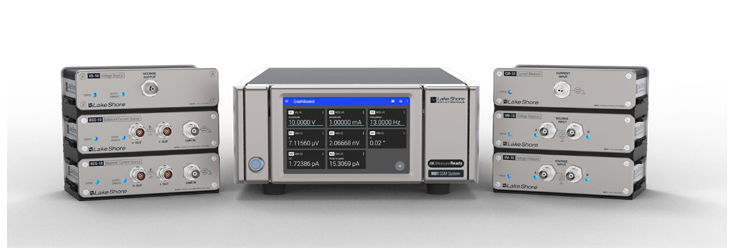 Figure 1: The Lake Shore M81-SSM instrument with its balanced current source, voltage source, current measure and voltage measure modules. Source: Lake Shore Cryotronics
The M81-SSM synchronous source measure system from Lake Shore Cryotronics helps address these measurement challenges. As a modular platform, the M81-SSM supports up to three source and three measure channels per half-rack instrument.
Its patented MeasureSync architecture uses a shared 375 kHz sampling clock to trigger every digital-to-analog converter (DAC) and analog-to-digital converter (ADC) simultaneously. This helps to ensure that all channels are sampled and updated at exactly the same instant. When using multiple modules, the system synchronously samples all source outputs and measure inputs at 375 kilosamples per second (kSa/s), providing tightly synchronized data collection, which aids in reducing data misalignment errors while facilitating accurate timing control for pulsed I-V and other time-dependent measurements that can help minimize heat build-up in low-power and emerging nanoscale devices.
In addition, the system combines low-noise source technologies with precision measurement capabilities and highly sensitive frequency-selective AC detection using an integrated lock-in.
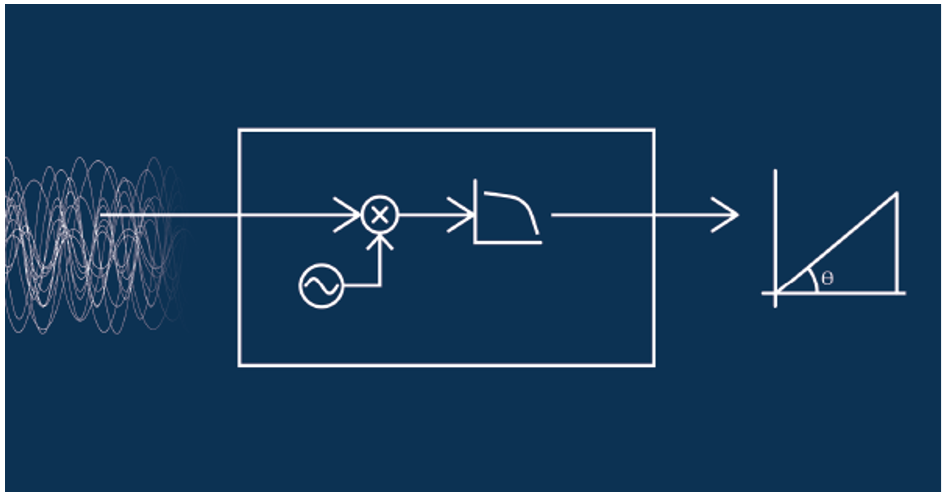 Figure 2: A simplified representation of the signal-processing approach used in lock-in-based AC measurements. Source: Lake Shore Cryotronics
Widely used in research laboratories for extracting extremely small signals from noisy measurement environments, lock-in detection utilizes frequency- and phase-sensitive measurement techniques to selectively measure only the desired signal. The source signal is set for AC at a user-defined amplitude and reference frequency, and the measurement processor "locks in" on that signal, using frequency- and phase-sensitive detection to help isolate the desired response from offsets and noise.
The M81-SSM system's maximum signal bandwidth of up to 100 kHz (I-range dependent) allows testing across a wide range of user-selectable frequencies, as well as DC, to optimize results by avoiding power line and other known interfering signals.
Additionally, the well-proven high sensitivity of such synchronous AC measurements significantly reduces the stimulus signal power applied to devices, helping eliminate unwanted thermal effects that could alter baseline characteristics. Also, because the system and all modules provide both AC and DC signals, users can easily switch between or combine DC and AC measurement modes without changing the physical setup.
What the SMU-10 module brings to the system
While the M81-SSM has been available with balanced current sourcing, current measurement, voltage measurement and voltage sourcing modules since its introduction, the newest addition, the SMU-10 module, consolidates these capabilities into a familiar source measure unit (SMU) format. Using this four-instruments-in-one capability, industry engineers can more easily perform a wide variety of sensitive, low-noise measurements.
Occupying one source channel and one measure channel within the M81-SSM architecture, the SMU-10 provides seven instrument functions: DC voltage source, AC voltage source, DC source, AC source, voltmeter, ammeter and lock-in detector. The SMU-10 extends the M81-SSM architecture by combining AC and DC source-measure functionality with synchronous AC detection measurements.
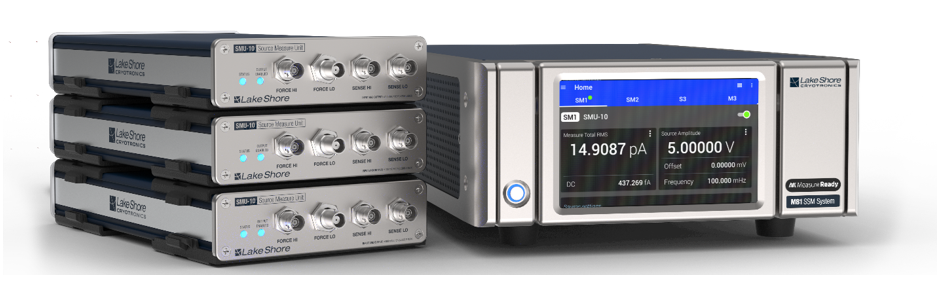 Figure 3: Three SMU-10 modules can be used with a single M81-SSM instrument, offering synchronized characterization of nanoscale devices. Source: Lake Shore Cryotronics
Plus, the SMU-10 inherits lock-in detection directly from the M81-SSM system. The user simply selects an excitation frequency well away from dominant noise source frequencies — above the 1/f noise corner of the device and well away from line-frequency fundamentals and harmonics — and the SMU-10’s built-in lock-in function extracts the in-phase (X) and quadrature (Y) components, or equivalently the magnitude (R) and phase (Θ), of the device response. No external lock-in amplifier, function generator or phase reference cable is required. This can improve the signal-to-noise ratio (SNR) when measuring extremely small electrical signals that may otherwise be obscured by noise.
The lock-in also uses a unique combination of an infinite impulse response (IIR) filter and a finite impulse response (FIR) filter to remove extraneous signals from the measured output. The combination of the two filters enables the SMU-10 lock-in to make faster measurements with shorter settling times without compromising the SNR.
Additionally, the M81-SSM system and SMU-10 source noise performance is several orders of magnitude below that of conventional DC SMUs. Measurement sensitivity is also improved by several orders of magnitude when using the AC/lock-in functionality. By combining AC sourcing and measurement capabilities with lock-in detection, the system can detect signals that would otherwise be difficult or impossible to resolve using conventional DC-only measurement techniques. Specifically, the SMU-10 combines DC sensitivity below 300 µV and 1 fA with lock-in AC sensitivity below 3 nV and 1 fA RMS at 1 kHz, while supporting source and measure levels up to ±10 V and ±100 mA.
Moreover, like all M81-SSM modules, the SMU-10 is a purely analog module without high-speed digital circuitry and the accompanying high-frequency noise. The M81-SSM's modular architecture physically separates the sensitive analog measurement circuitry from the M81-SSM instrument's high-speed digital processing and data converter electronics, allowing modules to be located very close to the device under test. Using the shortest possible signal-level test leads minimizes the addition of ambient, power line and machine noise that could otherwise contaminate low-level signals.
Applications ideal for the M81-SSM and its SMU-10
Low-resistance measurements with parasitic compensation
When the M81-SSM's lock-in mode is used to measure resistance, the system can compensate for phase shifts caused by parasitic cable capacitance and present a more accurate resistance measurement. This advanced AC resistance function operates with all combinations of M81-SSM modules, including the SMU-10 module.
This mode is particularly useful in cryogenic measurement applications, where low-temperature environments often introduce parasitic capacitances that cause the apparent phase of the measured impedance to deviate from its true value. The mode compensates for these phase shifts, helping ensure that measured resistance values more accurately reflect the device's intrinsic resistance rather than artifacts introduced by the measurement setup. This is valuable when characterizing structures where small resistance variations can be significant.
Characterizing low-level leakage currents in CMOS devices
As CMOS device dimensions continue to shrink, leakage current becomes both an increasingly important and a more difficult-to-measure parameter affecting overall device performance and power consumption. The SMU-10's low-noise source and measurement capabilities, including DC sensitivity below 100 fA, allow engineers to characterize extremely small leakage currents that may otherwise be obscured by noise.
In addition, the M81-SSM’s AC and DC measurement capabilities provide flexibility for evaluating low-current device behavior using the measurement technique best suited to the application. This capability is useful when evaluating advanced CMOS nodes, cryogenic CMOS devices and other nanoscale structures where leakage currents and other low-level electrical effects can significantly influence overall device performance.
Supporting scalable quantum device development
As quantum computing technologies progress toward larger, more complex systems, engineers require repeatable electrical characterization of the nanoscale device structures used to build qubits and supporting cryogenic electronics. In addition to providing low-noise source/measure capabilities with synchronized AC and DC measurements for evaluating device behavior across a range of operating conditions, the SMU-10 can also aid in differential conductance (dI/dV) and other small-signal electrical response measurements. These measurements often require detection of extremely small changes in current in response to an applied voltage, where environmental noise can easily mask the signals of interest. By combining traditional source-measure functionality with integrated lock-in detection, the SMU-10 can be used for sensitive characterization of quantum dots, Josephson junctions, superconducting circuits and other quantum device structures where low-level effects can influence performance, manufacturability and scalability.
Testing three-terminal devices
A single M81-SSM instrument can control up to three SMU-10 modules for synchronous and independent control of the gate, drain and source of a FET or other complex semiconductor devices. As an example, the system can sweep gate voltage while monitoring gate current and measuring channel current simultaneously. In addition, independent control of the gate and drain enables generation of transfer and output I-V curves for detailed characterization of device performance across multiple operating conditions. This capability is particularly valuable for nanoscale device characterization, where low signal levels and complex device behavior require tightly coordinated sourcing and measurement across multiple terminals.
Learn more about how the M81-SSM supports nanoscale device characterization, and watch a short video demonstrating FET I-V characterization with the system on the Lake Shore Cryotronics’ website.

Powered by CR4, the Engineering Community
Discussion – 0 comments
By posting a comment you confirm that you have read and accept our Posting Rules and Terms of Use.
Advertisement
Advertisement
Popular News
Find Free Electronics Datasheets

Advertisement