
Accessibility to 3D-printing technology and open-source designs provides those who are missing limbs the opportunity to print their own prosthetic devices. However, these DIY devices lack personalized electronic user interfaces such as those found in costly, state-of-the-art prosthetics. This limitation, which makes it difficult to assess whether the devices optimally contact soft tissue, is removed with a new 3D-printing process from Virginia Tech.
The system described in PLOS One integrates electronic sensors with personalized 3D-printed prosthetics. Embedding sensors at the intersection between a prosthetic and the remaining tissue enhances the collection of information related to prosthetic function and comfort, such as the pressure across the wearer’s tissue, that can help improve further iterations of the these devices.
Materials are integrated within form-fitting regions of 3D-printed prosthetics via a conformal 3D-printing 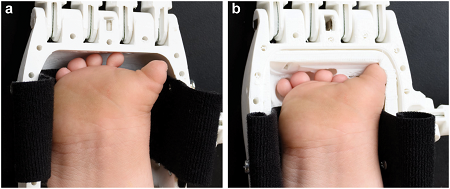 Verification of the 3D printed personalized prosthetic hand’s function via 3D scanning. Photographs of the participant’s hand inserted into both the non-personalized (a) and personalized prostheses (b). Source: Virginia Techtechnique using carbon nanotube-based polymer inks instead of manual integration after printing. The scheme allows for deposition of materials on curved surfaces and enables inclusion of sensors at different locations across the form-fitting interface.
The design begins with 3D scanning data of a limb, which serves as a guide for integration of sensors into the form-fitting cavity of the prosthetic. The process was first applied to the production of a prosthetic hand for a 12-year old and was fine-tuned with new additive manufacturing approaches to yield a more comfortable, form-fitting device. The customization increased the contact between the user’s tissue and the prosthesis by nearly four-fold as compared to non-personalized devices. The increased contact area helped the engineers pinpoint where to deploy sensing electrode arrays to test the pressure distribution.
Sensing tests conducted using two personalized prosthetics with and without sensing electrode arrays revealed that the pressure distribution was different when the user’s hand was relaxed versus flexed. The sensing electrode arrays could in the future help to improve device design and reduce the occurrence of such non-uniform pressure distributions.
