
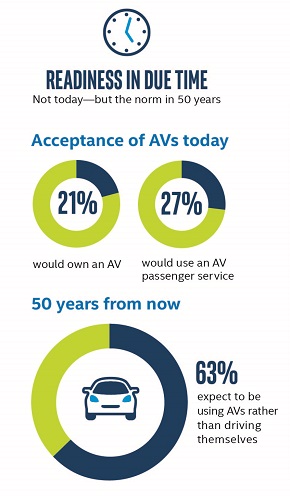
 Acceptance of autonomous vehicles. Source: IntelThe move to autonomous vehicles will begin slowly as companies across the automotive landscape begin to roll out next-generation cars in the coming years.
But according to a new study from Intel Corp., in about 50 years, self-driving cars will be commonplace. This coincides with a previous study Intel did last year that showed the autonomous driving market will generate a passenger-centric future worth $7 trillion by 2050.
That previous study said that self-driving vehicles have the potential to save about 585,000 lives from 2035 to 2045, however, given some of the current issues with autonomous vehicles — including the death of a pedestrian at the hands of an Uber test car — some consumers do not feel safe around the vehicles.
“We must bridge the gap between acceptance of today’s automated driving assist features and full autonomy,” said Jack Weast, senior principal engineer and vice president of AV standards at Mobileye, a division of Intel. “Today, passengers are asked to blindly trust a manufacturer’s ‘black box’ safety approach. What is needed is for the industry and policymakers to rally around a transparent safety model that builds trust between humans and machines.”
What Passengers Will Do
In the study, Intel asked consumers what they expect to do in a self-driving car in the next 50 years. The answers include:
- 58% said they would enjoy entertainment.
- 57% said they would socialize.
- 33% would host meetings.
- 26% would use the time to groom.
- 14% would use the time not driving to exercise.
In addition to providing passengers with the ability to do more than just commute or be behind the wheel, the U.S. Department of Transportation estimates self-driving cars could reduce traffic fatalities by 94% by eliminating accidents due to human error.
In order for widespread use of autonomous vehicles to take hold, availability, education and acceptance of advanced driver assistance systems (ADAS) will need to be a priority for developers, Intel said. Without these aspects, it is unthinkable for consumers to take a universal leap from driving themselves to letting the car do the work, the company added.
For more information about the study, go to Intel.
