
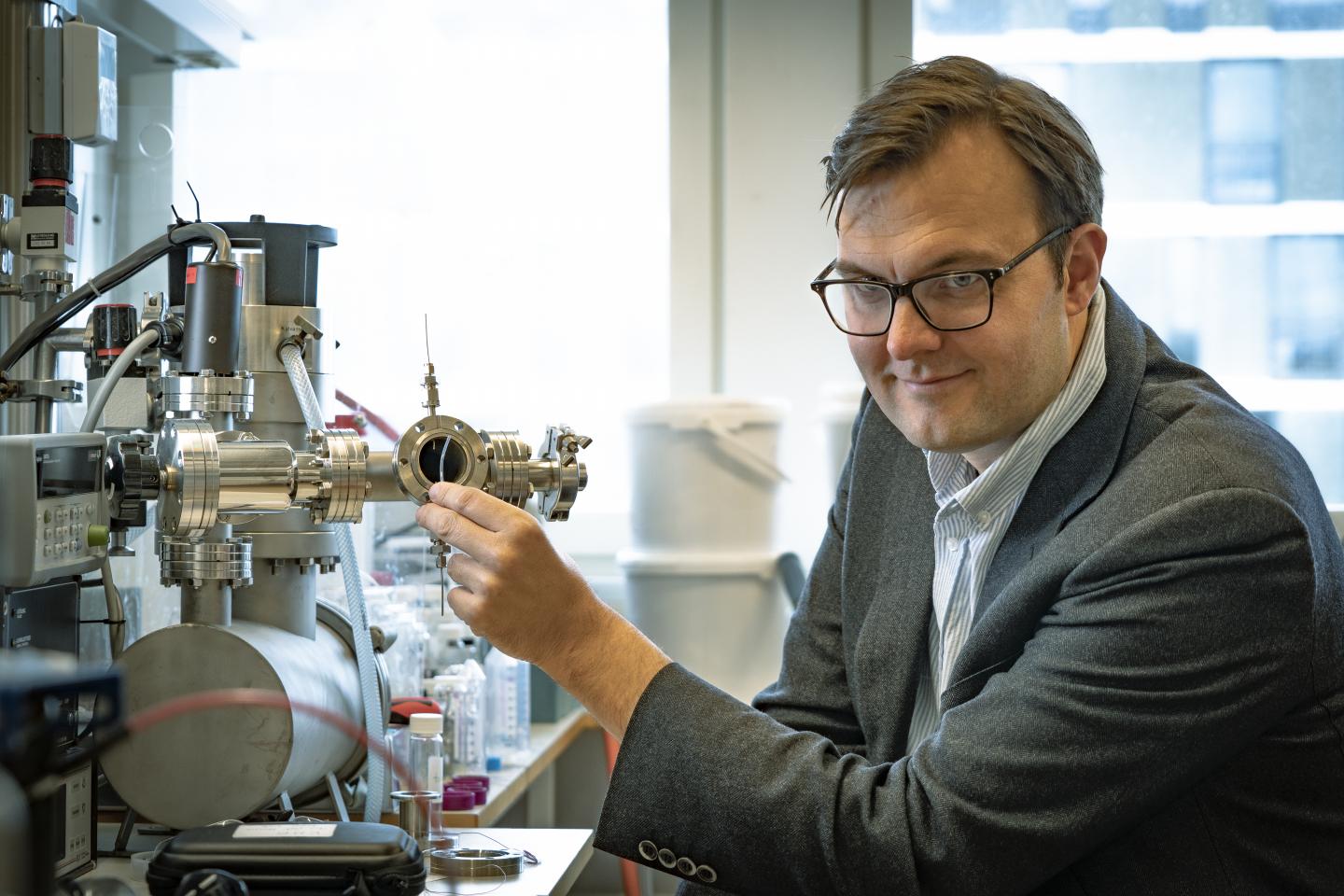
 Professor Kasper Moth-Poulsen holding a tube containing the catalyst in front of the ultra-high vacuum setup that was used to measure the heat release gradient in the molecular solar thermal energy storage system. Source: Johan Bodell/Chalmers University of Technology
A team from Chalmers University of Technology, Sweden, is one step closer to creating a completely emissions-free solar energy system. The latest development in this project is the creation of a specially designed molecule that can store solar energy for later use.
A year ago, the team created a molecule made of carbon, hydrogen and nitrogen that can successfully store solar energy. The molecule changes solar energy into an energy-rich isomer when it comes into contact with sunlight. Liquid isomers allow solar energy to be stored and saved for later use when solar activity is low. This new development is just one component of the new solar energy system called Molecular Solar Thermal Energy Storage (MOST).
"The energy in this isomer can now be stored for up to 18 years. And when we come to extract the energy and use it, we get a warmth increase which is greater than we dared hope for," said the leader of the research team, Kasper Moth-Poulsen, professor at the department of chemistry and chemical engineering.
The team has now taken another step toward a successful, emissions-free energy device with the development of a catalyst that can control the release of the stored energy. The catalyst acts as a filter for the energy. As the liquid energy flows through the catalyst and the reaction warms the liquid by 63° C. For example, if the liquid is at 20° C, once it flows through the catalyst, it will be heated to 83° C.
The new design could potentially store energy for 18 years, a major improvement over all of the team's other designs. The updated system is completely emissions-free.
The developments have allowed the MOST system to work in circular motions. The steps of the systems are as follows:
1. The liquid captures sunlight energy in a solar thermal collector.
2. The energy is then stored at room temperature to minimize the amount of energy loss over time.
3. When the energy is needed, it is drawn through the catalyst where it is warmed. The heating mechanism can be used for heating a home and allows the stored energy to be used to power a building.
"We have made many crucial advances recently, and today we have an emissions-free energy system which works all year around," said Moth-Poulsen.
The next steps for the team are to develop the system so it can work in real-life outside of the lab.
"There is a lot left to do. We have just got the system to work. Now we need to ensure everything is optimally designed," Moth-Poulsen added.
The paper on this system and its development was published in Energy and Environmental Science.
