
Researchers at Korea Advanced Institute of Science and Technology (KAIST) have developed a flexible robotic surgical system to work on difficult-to-reach places. The K-Flex endoscopic surgical robot has arms that are only 3.7 mm in diameter, allowing them to work through the standard 4.2 mm internal channels of an endoscope.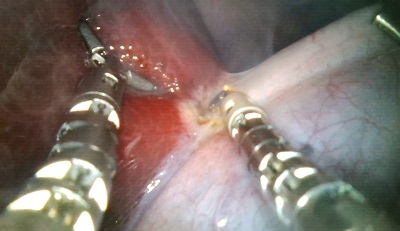 Robot arms perform an incision during an ex-vivo test on a porcine gallbladder. Source: KAIST
Since each robotic arm doesn’t need its own incision, as is usual with current robotic surgical assistants, the smaller K-Flex is less invasive and should lead to fewer complications for patients. It can be delivered through natural orifices, such as the mouth and anus, to sites that otherwise would require an external incision.
The system was tested in a porcine model during a procedure in which a lesion was removed from the pig’s gallbladder. The device was used to reach the organ via the navel, pushing other tissues out of the way and cauterizing the lesion using a special needle attached to the robotic arms.
The robot relies on mini-joints developed at KAIST that offer a great deal of flexibility while maintaining the strength necessary to work inside the human body. Since it is operated through an endoscope, the arms can be moved in and out of the surgical scene with ease while the endoscope provides the visualization inside.
