
Researchers at the University of Macau in China have developed new soft magnetic robots that are capable of climbing inverted surfaces and moving in complex environments, such as the GI tract for precise drug delivery, for instance.
According to the developers, the robots were designed to mimic the movements of the golden wheel spider, which can travel across assorted terrains via unique rolling motions.
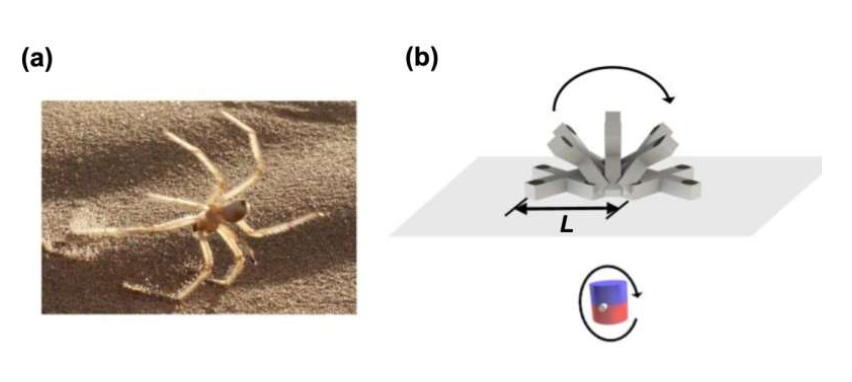 (a) Photograph of a golden wheel spider. (b) Schematic diagram of the BMSR's motion pattern during a single cycle. The BMSR can roll forward in response to a rotating magnetic field. The distance it rolls during one cycle is equal to its body length (L). Source: International Journal of Extreme Manufacturing (2025). DOI: 10.1088/2631-7990/ae0214
"In recent years, the rising incidence of GI cancer has triggered an urgent need for effective early intervention strategies," the researchers explained. "Traditional endoscopic techniques often cause patient discomfort, and it is difficult to navigate deep regions of complex organ structures. This work proposes a kind of bio-inspired magnetic soft robot (BMSR) to address these challenges."
The team built the robots using flexible and deformable materials that are less likely to damage tissue within the body, while also preventing discomfort in patients as the robots travel the GI tract.
Further, the spider-inspired robots feature two six-degree-of-freedom (6-DOF) robotic arms, wherein one arm is responsible for real-time manipulation of the BMSRs, while the second arm is designed to monitor their status.
The BMSRs can be controlled using a magnetic field applied from outside the body, which guides the robots’ movements without using onboard motors.
"Through the powerful output force, the BMSRs can overcome the mobility barrier induced by different human organs, including mucus, folds, and height differences of up to 8 cm," wrote the researchers. "Such an exceptional mobility enables the BMSRs to deliver drugs in the targeted complex GI environment. Moreover, in combination with an endoscope, it provides real-time visual feedback for precise navigation."
The team trialed the robots in the GI tract of deceased animals that share common features with humans. The team determined that the robots could deliver drugs to target locations without damaging tissues.
An article detailing the research, “Bio-Inspired Magnetic Soft Robots with Omnidirectional Climbing for Multifunctional Biomedical Applications,” appears in the journal International Journal of Extreme Manufacturing.
