
After a night of discussion with his wife and colleagues, Neal Stewart from the University of Tennessee came up with an idea. What if houseplants could signal the health of the owner’s home? Stewart teamed up with his colleagues from UT to study the potential for these decorative biosensors.
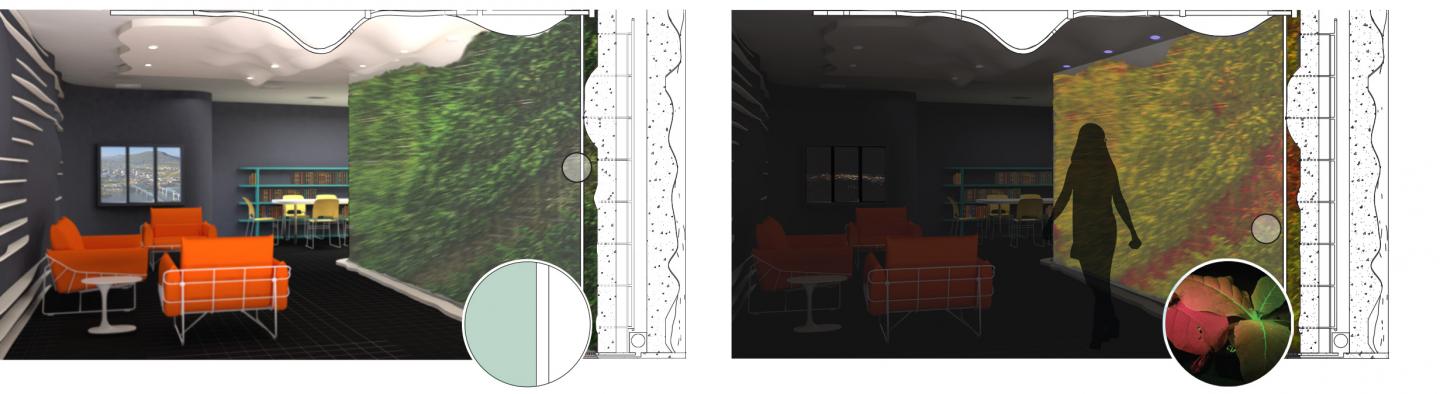 These are perspective images of a conceptual phytosensor (plant) wall. Shown left is the lighted room, and shown right is the darkened room under sense-and-report photonic conditions. Source: Francisco Palacios/Susan G. Stewart/Rana Abudayyeh
The design and construction of new biological entities and systems is known as synthetic biology, which has mainly been considered a tool for agricultural production. Engineered plants can react to certain atmospheric conditions, such as too much or too little nitrogen in the air, giving farmers a leg up on plant health. Stewart wondered if this same idea could be applied to common houseplants.
"Houseplants are ubiquitous in our home environments," says Stewart. "Through the tools of synthetic biology it's possible for us to engineer houseplants that can serve as architectural design elements that are both pleasing to our senses and that function as early sensors of environmental agents that could harm our health, like mold, radon gas or high concentrations of volatile organic compounds. They can do a lot more than just sit there and look pretty. They could alert us to the presence of hazards in our environment."
Plant biosensors could be designed to react to harmful agents in the home. In order to do this, dense populations would be needed. The team believes that creating a plant wall would be the most efficient way to create a wall of biosensors.
"Biophilic design builds on our innate affiliation with nature, so integrating biophilic elements within the interior volume carries rich implications spatially and experientially," says Rana Abudayyeh, an assistant professor in the UT College of Architecture and Design's School of Interior Architecture. "Building responsive capabilities into interior plants is revolutionary. It allows biophilic elements within space to assume a more integral role in the space, actively contributing to the well-being of the occupant holistically."
A paper on the potential for houseplant biosensors was published in the journal Science.
