
As chemical weapons go, nerve agents like VX and sarin — odorless, tasteless, difficult to detect — are among the deadliest substances on earth, able to cause severe illness and death within minutes. Eric Anslyn, a chemistry professor at the University of Texas at Austin who refers to chemical weapons as a dangerous threat to humanity, has been studying nerve agents for nearly 20 years.
Anslyn has developed chemical compounds that give off a fluorescent glow when they encounter the substances, with a color and brightness that offers clues to what types and amounts of nerve agents are present. Those distinctions are crucial, since different categories of nerve agents require different decontamination procedures and treatments — and analysis must be swift in order to effectively counteract the fast-acting poisons. Outside the lab, however, the expense and non-portability of instruments used to measure differences in color and brightness is a significant limitation.
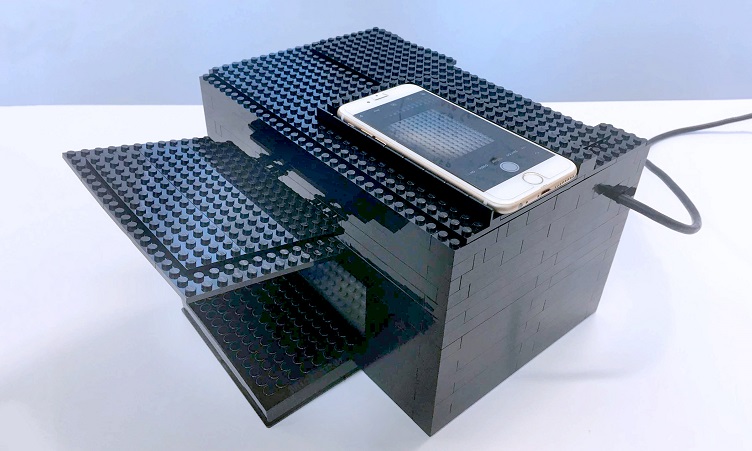
That is, until now: UT Austin researchers have created a simple and portable device to identify and detect nerve agents that makes use of Lego bricks and an iPhone. Yes, you read that right: The sensitive camera on the phone is used to take a picture of the glowing reaction, within a light-tight box formed by the Legos. Software developed in the lab by grad student Alexander Boulgakov is then used to analyze the picture.
The availability of the components is intended to make the technology readily accessible; a 3D-printed box was originally considered, but because 3D printers and materials can be inaccessible, uneven or cost-prohibitive in some parts of the world, the team decided upon the bricks instead.
"Legos are the same everywhere you go," said Pedro Metola, a clinical assistant professor at UT who was the first to suggest the idea.
In addition, the software developed by Boulgakov, along with image guides and a demonstration video, is available for free on GitHub. It can be adapted for multiple smartphone systems. The only other equipment necessary is an ultraviolet light and standard 96-well test plate.
The research appears in the open-access journal ACS Central Science.
