
An international research team, led by researchers from Rutgers University, has solved a question that has been plaguing physicists for years: can ferroelectric materials conduct electricity, even though they are not naturally occurring materials in nature?
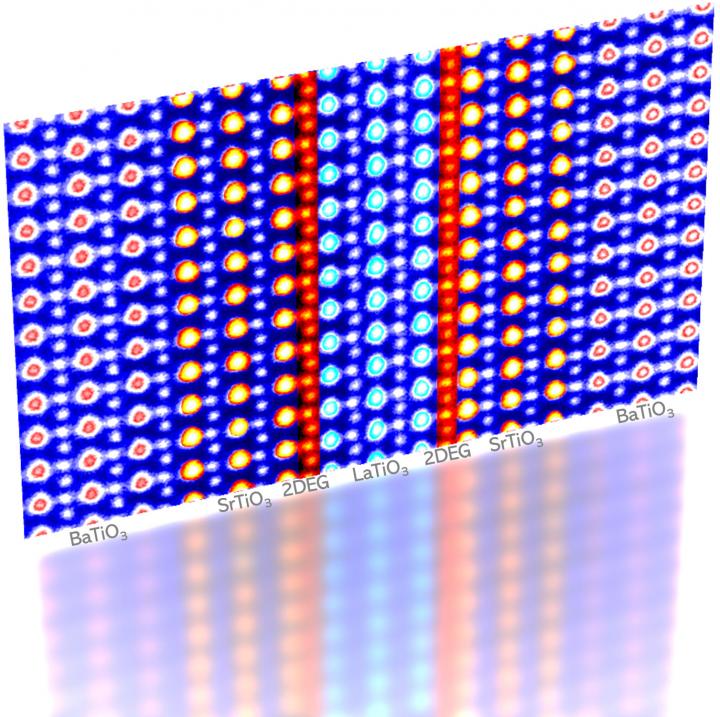 This image shows the positions of atoms in a ferroelectric-like metal that contains barium titanate, strontium titanate and lanthanum titanate. (Source: Zhen Wang and Yimei Zhu; image obtained at Brookhaven National Laboratory)
In 1965, Princeton University researcher Philip W. Anderson theorized that ferroelectric materials can conduct electricity. Until now, this theory has been impossible to prove. The international team was able to confirm this theory using state-of-the-art technology.
"We created a new class of two-dimensional artificial materials with ferroelectric-like properties at room temperature that doesn't exist in nature yet can conduct electricity. It's an important link between a theory and an experiment," said Jak Chakhalian, a team leader of the study and Professor Claud Lovelace Endowed Chair in Experimental Physics at Rutgers University-New Brunswick.
Ferroelectric materials are used in a wide variety of devices. These devices include cell phones, computer storage, medical equipment, high precision motors, ultra-sensitive sensors, sonar equipment and more. Even though it is used in these devices, it is not used to conduct electricity. The new development in ferroelectric materials could change its use in electronics completely and give way to a new generation of devices and electronics.
Chakhalian started this research because he was determined to prove a 53-year-old theory. He could not find a physics law that says ferroelectric materials cannot be created, so he had nothing holding him back. Chakhalian and his team used state-of-the-art technology to create sheets of materials that are atoms-thick and conduct electricity.
"Ferroelectrics are a very important class of materials technologically," he said. "They move, shrink and expand when electricity is applied and that allows you to move things with exquisite precision,” said Chakhalian, "When a material becomes ferroelectric, its atoms shift permanently and we wanted to add metallic properties to an artificial crystal that conducts electricity," he said. "So we took two very thin layers to create a two-dimensional metal at the interface and added a third layer with special properties to shift the atoms in that metallic layer, creating a ferroelectric-like metal. The new structure has several functionalities built-in, and this is a big win-win."
The paper on this research was published in Nature Communications.
