
Ultrasound technology, used for medical imaging for more than half a century, may soon be getting an upgrade thanks to a new material created by an international team of researchers.
The impetus to create the material came from the development of a theoretical basis for ultrahigh piezoelectricity in ferroelectric materials. Piezoelectricity is the property at the heart of medical ultrasound, active vibration control, sonar and more; a piezoelectric material mechanically deforms when an electric voltage is applied, and generates an electric charge when a mechanical force is applied.
Guided by the theory, the researchers added small amounts of samarium, a rare earth material, to lead magnesium niobate-lead titanate (PMN-PT), a high-performance piezoelectric ceramic. The result was a new material with twice the piezo response of any existing commercial ferroelectric ceramics.
It’s an unusual way to go about materials development. "The majority of existing useful materials are discovered by trial-and-error experiments,” said Prof. Long-Qing Chen of Penn State. “But here we designed and synthesized a new piezoelectric ceramic guided by theory and simulations."
"This work is based on an understanding of the origin of ultrahigh piezoelectricity in the ferroelectric crystals that were developed 30 years ago,” adds Shujun Zhang, a former Penn State professor who is now at the University of Wollongong in Australia. “Our new understanding suggested that local structure heterogeneity plays an important role in piezoelectricity in ferroelectrics, which also can be extended to other functionalities."
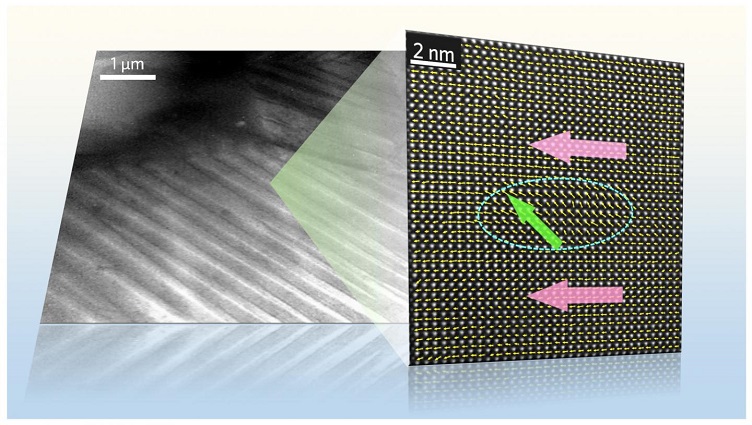
Zhang is referring to nanoscale-size structural distortions within a host material created by doping a small amount of chemical species -- in this case, samarium. This modifies the thermodynamic energy landscape of the material. In turn, the material’s dielectric properties, or responsiveness to an electrostatic field, and the piezoelectric effect are increased.
Made by a group at the University of Southern California, a device called a needle transducer already uses a submillimeter piezoelectric element of the researchers’ new material. When fitted into a standard needle or catheter, it can perform minimally invasive procedures – such as producing images or guiding precision surgery inside the body.
A provisional patent on the new material has been filed by Penn State. The research appears in a recent edition of Nature Materials.
