
An AI-powered robotic guide dog, developed to help visually impaired individuals navigate their surroundings, was recently debuted by Mila of the Quebec AI Institute and Polytechnique Montreal.
Described by its developers as the world’s first fully autonomous robotic guide dog, Milo was designed as a less expensive solution to living guide dogs that tend to be in short supply, require extensive training and can cost in the neighborhood of tens of thousands of dollars to train. The team suggests that Milo could be manufactured for less than $2,000.
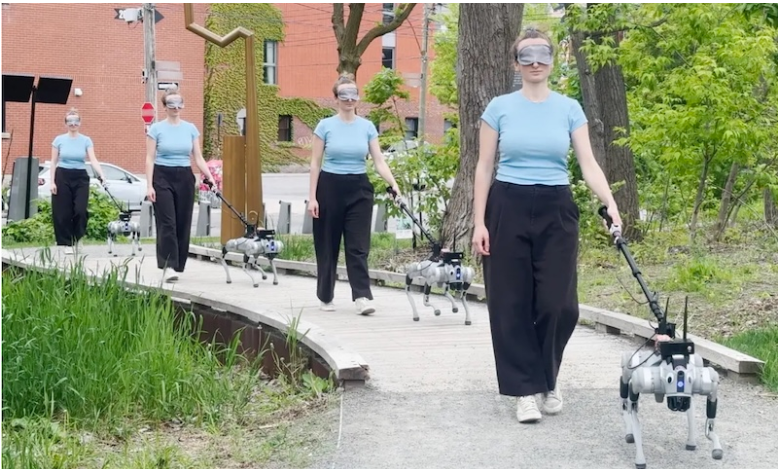 Source: Quebec AI Institute, Polytechnique Montreal
Further, Milo is capable of navigating unknown locations without needing to perform an initial 3D scan. Milo uses onboard AI to navigate indoor and outdoor environments, avoiding pedestrians and obstacles without relying on internet or cloud connectivity. The robot’s navigation system was trained through reinforcement learning in a custom simulator with diverse virtual environments and obstacles.
As Milo travels, the robot creates and maintains a map of its surroundings, which enables it to remember obstacles no longer directly visible instead of reacting only to what its sensors detect in the moment.
Sensors built into a telescopic handle enable the robot to safely navigate its surroundings by tracking the handler’s position. Meanwhile, a directional control pad lets users adjust their walking speed and indicate the direction they want to travel.
So far, the team has evaluated Milo on indoor and outdoor obstacle courses, where it was measured in terms of navigation accuracy, travel speed and obstacle clearance, suggesting that Milo will make robotic mobility assistance more accessible to people unable to access an actual guide dog.
