
Researchers at Rice University have engineered a new type of multiferroic that has a higher performance at room temperature than its parent material.
Scientists developed a modified version of bismuth ferrite that shows a 10 times increase in magnetization and a 100-fold increase in magnetoelectric coupling compared to standard varieties of multiferroic. Researchers did this by mixing bismuth ferrite with barium titanate while growing the material as a thin film on a substrate that distorts its crystal structure simultaneously.
“Nobody had ever dialed both knobs — the strain and the chemistry — at once,” said Lane Martin, a Rice materials scientist. “We were able to combine two different material systems into a new material with a new structure and a new combination of properties.”
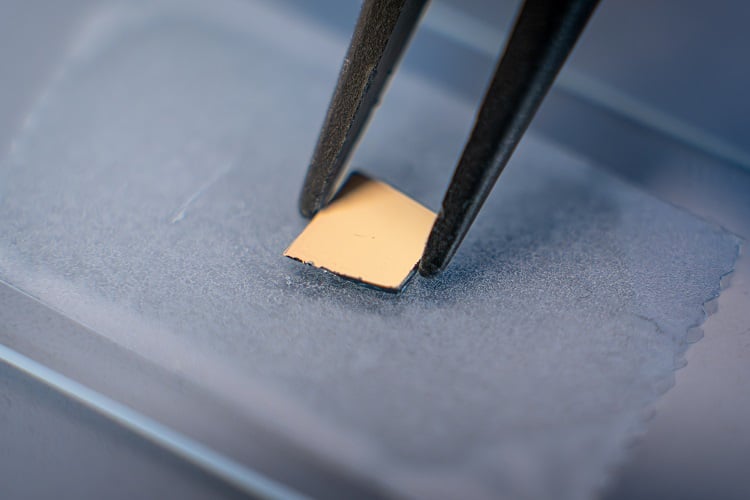 The multiferroic material that the Rice University researchers developed shows a 10 times increase in magnetization and a 100-fold increase in magnetoelectric coupling. Source: Rice University
Why it matters
Multiferroics are promising because of the coupling of different properties — known as magnetoelectricity — that allows for an electric field to change a material’s magnetism or a magnetic field to change its polarization.
This could allow for the basis of performing memory and logic operations using less energy and even combining the two functions in a single element. However, the challenge is finding a single material that has both strong ferroelectric and strong magnetic features at room temperature.
Martin explained that modern electronics face a growing energy challenge, with computing expected to consume between a quarter and a third of global power generation within the next five to 10 years. This is unsustainable, he added.
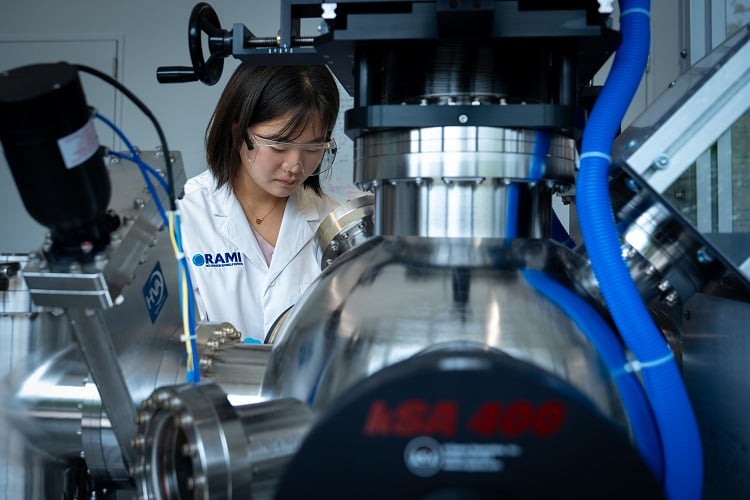 Tae Yeon Kim, a postdoctoral researcher at Rice University, works in the lab that created a multiferroic material that has a high performance at room temperature. Source: Rice University
Exploring properties
Engineers are exploring ways to use additional properties of electrons and other fundamental particles for new forms of computation.
“Multiferroics have, as the name implies, multiple order parameters,” Martin said. “Ones we are most interested in are ferroelectric, so they have a spontaneous polarization which you can switch with an electric field and are also magnetic.”
Rice University researchers said beyond the promise of their new material, combining chemistry and straining to create structures with unexpected properties — like adding nonmagnetic atoms making a material more magnetic — could guide future material designs.
The full research can be found in the journal PNAS.
