
A low-cost, portable laboratory that is loaded onto a smartphone has been developed for doctors to take on the go. The laboratory works nearly as well as a clinical laboratory to detect common viral and bacterial infections.
The mini-lab could lead to faster and cheaper lab results for fast-moving viral and bacterial epidemics all over the world, but it could be especially helpful in lower-resource regions that don’t have medical equipment available.
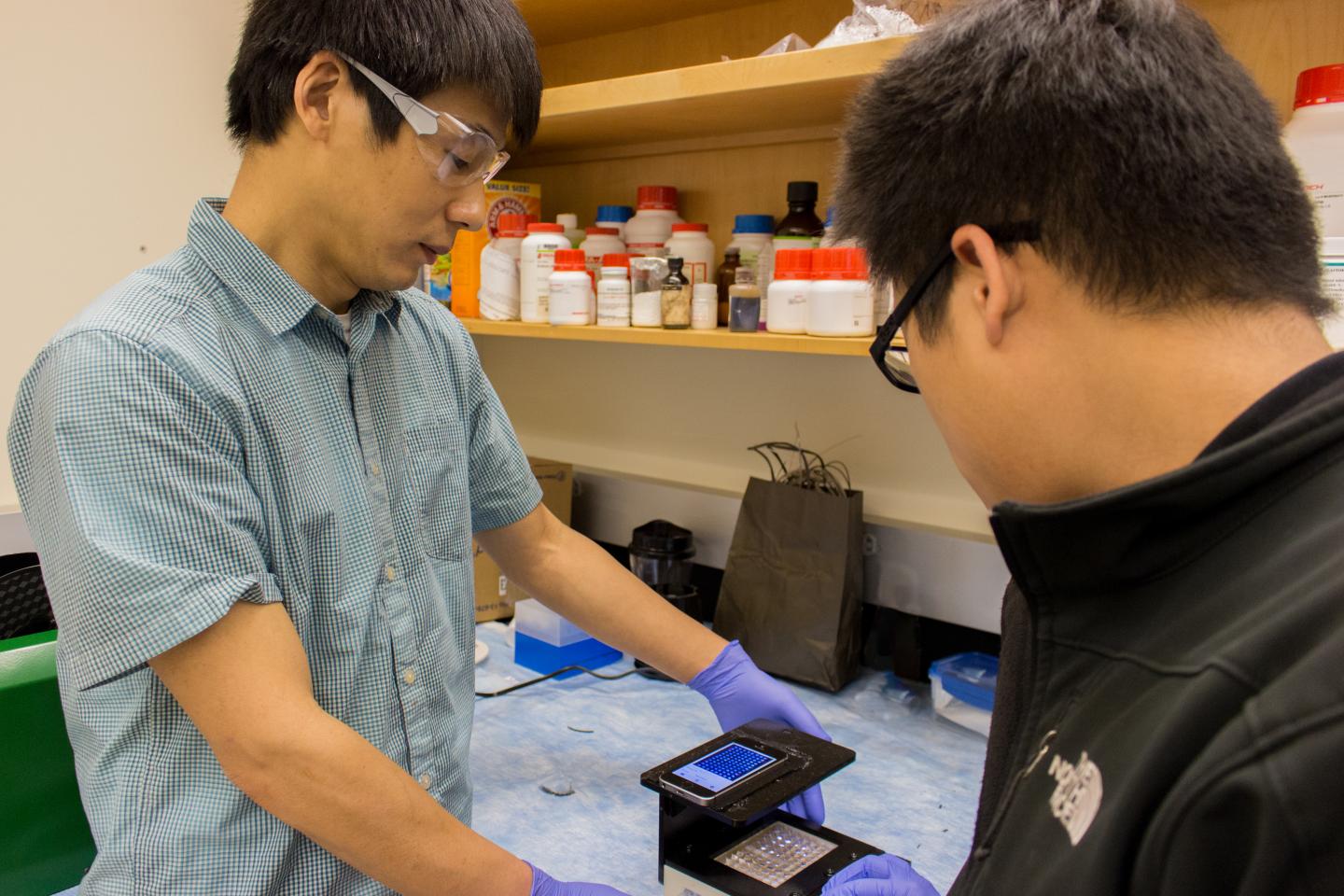 WSU Professor Lei Li and graduate student Yu-Chung Chang (l-r) test the new smartphone that detects 12 common viral and bacterial infectious diseases. Source: Washington State University
A team of researchers from Washington State University, led by Lei Li, an assistant professor in the School of Mechanical and Materials Engineering, are the main researchers behind the mini-lab. This team worked with Ping Wang, associate professor of Pathology and Laboratory Medicine at the University of Pennsylvania’s Perelman School of Medicine. Wang was a key member to creating the design and implementation of the clinical study for the smartphone lab.
In rural areas, it can be difficult for a doctor to find exactly what disease or infection the patient has because they have to rely on the patient’s judgment on their own systems, rather than clinical testing. This is because the medical technology may not be readily available in these areas. Often the current process used in the rural climates are inaccurate. To receive accurate results, doctors have to send off tests to a lab in a city and sometimes it can take days to find the results, and by then it may be too late for the patient. There are some mobile health diagnostic devices that are currently being used, but these devices are only able to analyze a single sample at a time.
During clinical studies, the new smartphone reader worked almost as well as standard lab testing when testing 12 common viral and bacterial infectious diseases. The device was tested with 771 patient samples in the Hospital of the University of Pennsylvania. During this testing, the device had false positives only 1 percent of the time.
The smartphone reader takes a photo of 96 sample wells at once. It then uses a computer program that analyzes color to find its results.
"This smartphone reader has the potential to improve access and speed up healthcare delivery," said Li. "If we find out about infections, we can treat them more quickly, which makes a difference especially in low-resource, remote areas."
The team built the device for around $50 for testing, but they say that it will be able to be manufactured for even less.
The paper on this research was published in Clinica Chimica Acta.
