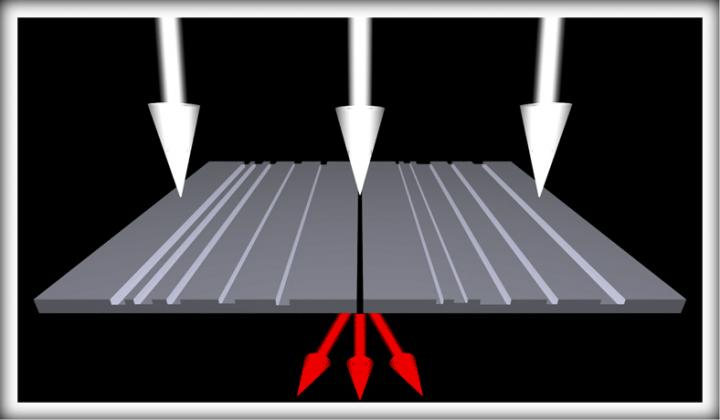
 Schematic shows two different ways that white light interacts with a newly developed device, a directional color filter ruled with grooves that are not uniformly spaced. When white light illuminates the patterned side of the compact metal device at three different angles -- in this case, 0° degrees, 10° and 20° -- the device transmits light at red, green and blue wavelengths, respectively. When white light incident at any angle illuminates the device from the non-patterned side, it separates the light into the same three colors, and sends off each color in different directions corresponding to the same respective angles. (NIST)
A team of scientists from the National Institute of Standards and Technology (NIST) has developed nanoscale devices that divide incident white light into its component colors based on the direction of illumination or directs these colors to a predetermined set of output angles.
When viewed from afar the device, called a directional color filter, resembles a diffraction grating, a flat metal surface containing parallel grooves or slits that split light into different colors. But, unlike a grating, the nanometer-scale grooves etched into the opaque metal film are not equally spaced. They are either a set of grooved lines or concentric circles that vary in spacing, much smaller than the wavelength of visible light. These properties shrink the size of the filter and allow it to perform more functions than a grating can.
For instance, the device’s non-uniform grid can be tailored to send a particular wavelength of light to any desired location. The filter has several promising applications, including generating closely spaced red, green and blue color pixels for displays, harvesting solar energy, sensing the direction of incoming light and measuring the thickness of ultrathin coatings placed atop the filter.
In addition to selectively filtering incoming white light based on the location of the source, the filter can also operate in a second way. By measuring the spectrum of colors passing through a filter custom-designed to deflect specific wavelengths of light at specific angles, researchers can pinpoint the location of an unknown source of light striking the device. This could be critical to determine if that source is something like a laser aimed at an aircraft.
"Our directional filter, with its aperiodic architecture, can function in many ways that are fundamentally not achievable with a device such as a grating, which has a periodic structure," said NIST physicist Amit Agrawal. "With this custom-designed device, we are able to manipulate multiple wavelengths of light simultaneously."
A paper on this research was published in Nature Communications.
