
A heart sensor that can adhere to skin was engineered by researchers from the RIKEN Japanese research institute and University of Tokyo. The flexible body-worn monitor requires no batteries to function but relies instead on solar energy.
The device design integrates organic electrochemical transistors used as sensors with organic photovoltaic 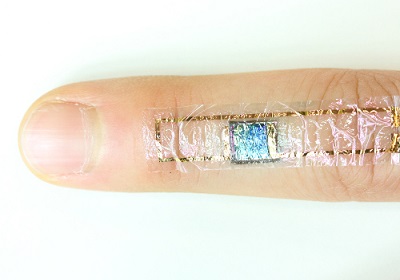 The flexible device on a finger. Source: RIKENpower sources on a one-micrometer-thick ultra-flexible substrate. A nano-grating surface on the light absorbers of the flexible solar cell allows for high photo-conversion efficiency (PCE) and light angle independency. A PCE of 10.5% and a high power-per-weight ratio of 11.46 W/g was demonstrated, bringing the technology closer to the 15% required to make organic photovoltaics competitive with silicon-based counterparts.
A PCE decrease of only 25%, from 9.82% to 7.33%, was observed under repetitive compression tests involving 900 cycles, as was a higher PCE gain of 45% compared to non-grating devices under 60 degree light angle.
The device was also shown to facilitate the self-powered detection of heartbeats either on the skin or to record electrocardiographic (ECG) signals directly on the heart of a rat. Effective performance was documented at a lighting level of 10,000 lux, equivalent to the light seen when one is in the shade on a clear sunny day. The signal-to-noise ratio was lower compared with similar battery-connected devices, which is ascribed to the lack of electric wires.
