
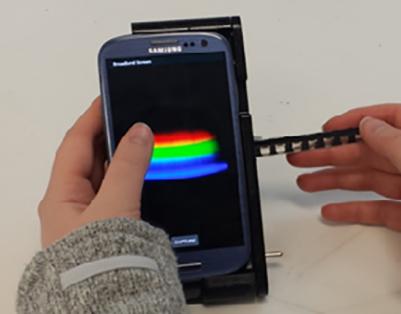
 The spectral transmission-reflectance-intensity (TRI)-Analyzer attaches to a smartphone and analyzes patient blood, urine or saliva samples as reliably as clinic-based instruments that cost thousands of dollars. Source: Department of Bioengineering, University of Illinois at Urbana-Champaign
Researchers from the University of Illinois at Urbana-Champaign have developed a technology that enables a smartphone to perform lab-grade medical diagnostic tests that usually require large and expensive instruments. The technology is a spectral transmission-reflectance-intensity(TRI)-Analyzer and it only costs $550. Brian Cunningham, Bioengineering and Electrical & Computer Engineering Professor, is the main researcher behind the new technology. The TRI Analyzer attaches to a smartphone and analyzes a patient’s blood, urine or saliva samples as reliably as the clinic-based instruments that can cost thousands of dollars.
"Our TRI Analyzer is like the Swiss Army knife of biosensing," said Cunningham, the Donald Biggar Willett Professor of Engineering and director of the Micro + Nanotechnology Lab at Illinois. "It's capable of performing the three most common types of tests in medical diagnostics, so in practice, thousands of already-developed tests could be adapted to it."
Cunningham’s team used the TRI Analyzer to perform two assays—to test a biomarker associated with pre-term birth in pregnant women and the PKU test for newborns to indirectly detect an enzyme that is essential for normal growth and development. The test results were comparable to the ones acquired with clinic-grade spectrometer instrumentation.
Many diagnostic tests can be adapted to their point-of-care smartphone format, including an enzyme-linked immunosorbent assay (ELISA) that detects and measures a wide array of proteins and antibodies in the blood. It is commonly used for many health diagnostics tests. The system can detect the output of any test using a liquid that changes color or a liquid that generates light output, like fluorescent dyes.
The TRI Analyzer works by converting the smartphone camera into a high-performance spectrometer. The analyzer illuminates a sample fluid with the phone’s internal white LED flash or with an external green laser diode. The light from the sample is collected in an optical fiber and guided through a diffraction that is grading into the phone’s rear-facing internal camera. The optical components are arranged within a 3D-printed plastic cradle.
The TRI Analyzer can measure multiple samples at the same time by using a microfluidic cartridge that slides through an opening in the back of the cradle. This makes the Analyzer suitable for patients who don’t have convenient access to a clinic or hospital with diagnostic test facilities or for patients with urgent health situations that require quick results.
"Our Analyzer can scan many tests in a sequence by swiping the cartridge past the readout head, in a similar manner to the way magnetic strip credit cards are swiped," said Long.
The TRI Analyzer can also be applied to point-of-use applications, including animal health, environmental monitoring, drug testing, manufacturing quality control and food safety. This technology is currently available for license.
To read the study on this new technology, visit the Lab on a Chip site here.
