
New technology that enables digital devices to confirm their identity through their own physical characteristics, thereby potentially offering a faster and more secure alternative to conventional passwords and security keys, has been developed by a team of researchers at King Abdullah University of Science and Technology (KAUST).
The team sought to tackle the growing challenge of securely verifying the authenticity of devices in expanding cloud, artificial intelligence (AI) and connected networks to prevent counterfeiting and compromise.
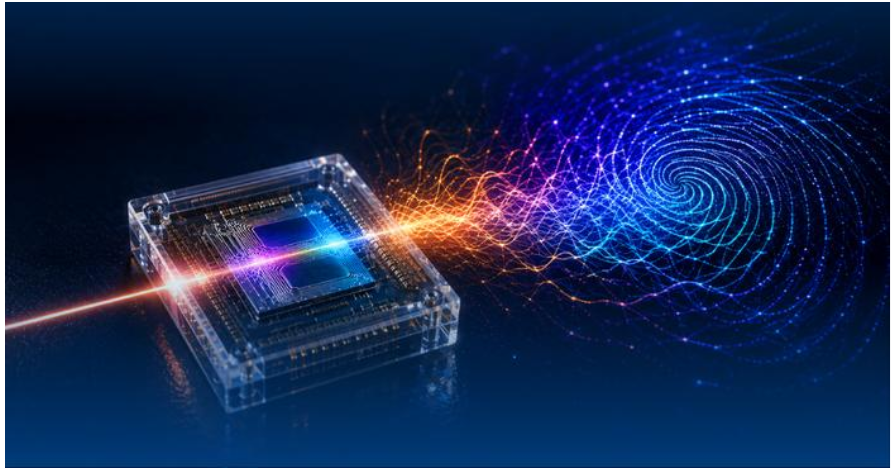 Source: KAUST
As such, the KAUST team created a system that employs tiny laser devices to produce unique digital fingerprints. These tiny lasers, much like human fingerprints, produce their own distinct light patterns that can be used to confirm identity.
With the addition of AI, the team enabled the system to recognize and then authenticate those laser fingerprints almost immediately.
"Every connected device needs a way to prove that it is genuine," the team added." Today this often relies on stored passwords or security keys. Our approach explores whether devices can instead identify themselves using characteristics that are inherently part of the hardware."
According to its developers, the technology could enable fast, energy-efficient authentication across large digital networks, including cloud computing, AI infrastructure and connected devices, while also supporting high-performance, secure communications.
An article detailing the technology, “Physical unclonable functions based on chaotic vertical-cavity surface-emitting lasers for dynamic authentication,” appears in the journal Nature Electronics.
