A team of engineers from Tufts University has developed flexible electronics for wearable devices that are so thin, they are barely detectable by the wearer.
According to its developers, the wearable devices made of these thread-based integrated circuits can bend, coil, stretch and conform to the body's contours and movements.
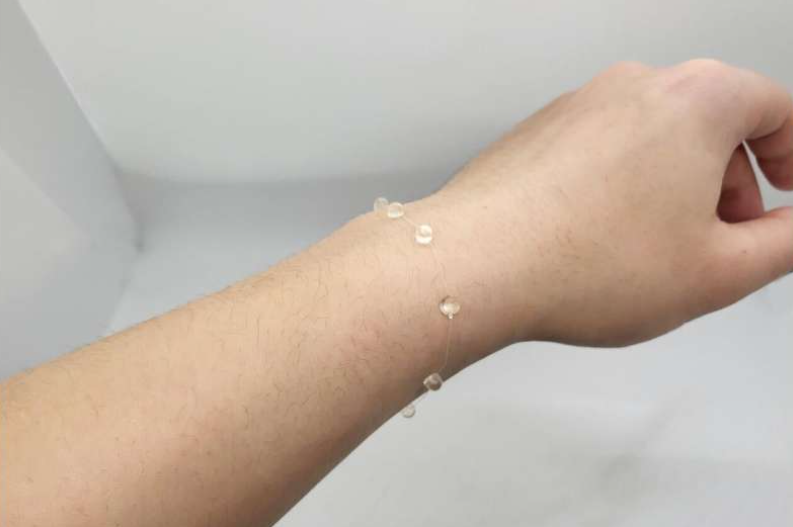 Source: Wenxin Zeng
These wearable devices, which can be sewn into clothing, wrapped around curved and movable surfaces, or exist free-form, can be worn on the body or adhered to the skin to track a range of biomarkers or environmental conditions. Meanwhile, artificial intelligence (AI)-driven applications could weave together the resulting data into potential insights for fitness, health care and recovery from injury or disease.
A team created integrated circuits in thread form, enabling soft, flexible wearable electronics that can be woven into clothing, worn on the skin or used as smart sutures. Prototype devices successfully monitored blinking and breathing, demonstrating the technology's potential for comfortable, continuous health monitoring, with the team eventually focusing on improving performance and functionality.
The team noted that gold-coated thin threads run throughout the device circuit and tiny, flexible transistors — which are central to any digital device — are attached to the thread. Further, the thread features a conducting plastic-like material that bridges the gold thread leading into and out of the transistor. Meanwhile, the flow of electrons at the transistor can be turned on and off, much like a spigot, according to a second current that controls a "gate," which functions like a valve.
Making the thread devices possible is a gel, dubbed eutectogel, that helps create a gap of less than 1 millimeter between two ends of the electronic thread where the flow of electrons can be controlled — be it in a thread-based resistor, capacitor, sensor or other component.
In addition to being stable, soft and compatible with contact on or in the body, the eutectogel also enables the transistor to "self-repair.” In the event that the gel breaks, the pieces can be brought back together by applying gentle heat to restore its mechanical and electrical function.
An article detailing the threads, “Free-Form Three-Dimensional Integrated Circuits on a Thread Using Organic Eutectogel-Gated Electrochemical Transistors,” appears in the journal ACS Applied Materials & Interfaces.
