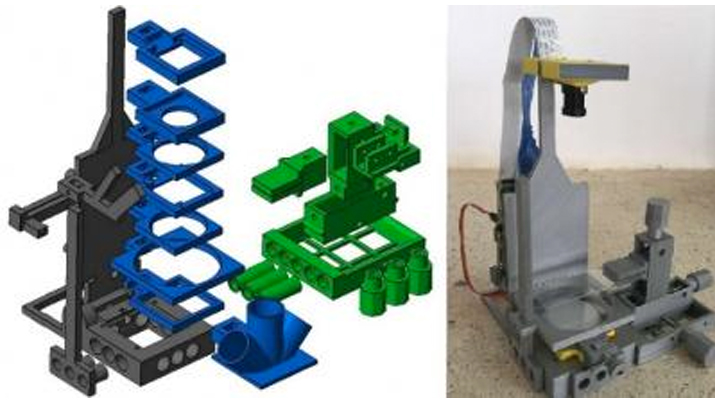
 3-D model of FlyPi system (left), next to an assembled version. Image credit: Tom BadenThe pursuit of neuroscience can be costly, particularly when it comes to lab equipment. Costs of commercially-available solutions can easily run into the tens or even hundreds of thousands; as a result, top-level research and training often gets confined to well-endowed institutes in rich countries.
But as shown in a recent study, many experiments can be performed using self-programmed electronics and self-assembled setups involving 3-D printed components.
Study co-authors André Maia Chagas, from Germany's University of Tübingen, and Tom Baden, from the U.K.'s University of Sussex, developed “FlyPi” as a low-cost imaging and microscope system for research, training and teaching.
The system can perform standard lab protocols, including light and fluorescence microscopy, optogenetics and thermogenetics. It can also perform behavioral studies on a variety of small laboratory animals, such as roundworms, fruit flies and zebrafish larvae. FlyPi’s design is based on a 3-D printed framework that holds a Raspberry Pi computer and camera, inexpensive LEDs for lighting and simple lenses. There are also optical and thermal control circuits based on open-source microcontroller Arduino. The basic system costs less than 100 Euros (about U.S. $115), and offers low-cost modular options for research and assembly. Instructions for use are made freely available via open-source platforms.
Along with study co-author Lucia Prieto Godino of Switzerland's University of Lausanne, FlyPi’s developers have put their open-source philosophy into action in Africa, teaching courses in 3-D printing, programming and DIY lab equipment at universities in Kenya, Uganda, Ghana, Nigeria, South Africa, Sudan and Tanzania.
"Many institutions around the world have little money to spend on costly equipment," says Baden. "We think it is very important that neuroscientific training and research open up to larger numbers of students and junior scientists. So we hope that, with open labware such as our FlyPi, we can offer a starting point."