
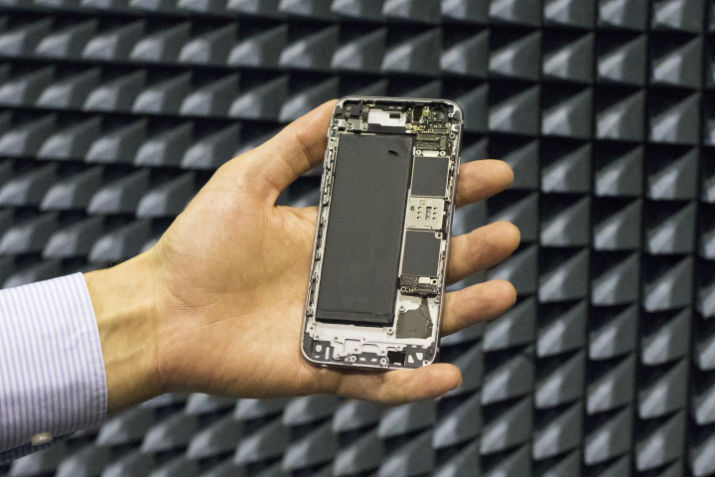
 The phone's antennas are placed in the top and bottom, which means that the phone's touch screen does not cover the entire phone. (Image Credit: Aalto University)
“Traditionally one antenna works with either one or a few different frequencies. Now we can take advantage of advanced digital electronics and combine several small antenna elements to work together as one antenna that can be made to operate digitally with any frequency,” said Jari-Matti Hannula, doctoral candidate at Aalto University. “In this way, many smartphone applications like GPS, Bluetooth and Wi-Fi will no longer need their own antennas.”
What the team suggests instead is that all of the phone's data transfer can take via one digitally controlled antenna. This smaller antenna would also make the phone design simpler and allow for larger screens.
In addition, the new antenna opens the doors to a new data transfer achievement, making it possible to reach the data transfer speed set as the objective for the next generation of phones – which is 100 to 1000 times faster than that of current phones. Battery life would also benefit from the new antenna design’s efficiency.
The new method allows for greater bandwidth, which leads to a higher data transfer speed and improved efficiency. These new antennas may also dispose of the analogue components that traditional antennas use to tune into the desired frequency. This eases the antenna design and allows for the development of more compact antennas with better radiation efficiency.
Antennas that are designed using the standard technology can obtain either a broad frequency range or high efficiency, but never both at the same time.
As antenna radiation efficiency decreases, as it has been in the recent past due to increased frequency range used by mobile phones, this drop in radiation efficiency has led to a short transmission range.
This has forced network operators to compensate with a denser network of base stations, in turn wasting energy in both the phone and base station and raising costs.
According to Professor of Radio Engineering Ville Viikari the new method will “revolutionize the fifth generation of mobile phones and maintain Finland as one of the leading countries in the development of mobile phone antennas.”
“The next step in the development process is under way with the commencement of tests in cooperation with Huawei using fifth generation mobile phone devices. We are also developing together with Aalto University researchers’ digital electronic systems for controlling the antennas,” said Viikari.
