
Editor's note: This article was republished to remedy an image inaccuracy. We apologize for this error.
The demand for reliable, high-capacity batteries is on the rise due to the increasing global investment in renewable energy. The market is presently dominated by lithium-ion batteries (LIBs), although researchers are actively seeking alternatives due to concerns about limited lithium supply and limits in energy density. The importance of investigating alternative battery chemistries in ensuring the sustainability and security of energy in the long run is growing.
There are a number of benefits to using calcium-ion batteries (CIBs). Aside from the abundant supply of calcium, CIBs also function within an electrochemical window similar to that of LIBs. Despite the potential, they have faced obstacles that have hindered their advancement. Achieving efficient calcium ion migration inside the battery and maintaining consistent performance over numerous charging cycles have both proven to be challenging. Therefore, there has been no direct competition between CIBs and commercial lithium-ion devices due to these constraints.
The electrochemical advantage of calcium-based energy storage
Initially, lithium appears to be the optimal material for a rechargeable battery due to its superior negative redox potential among all elements. Nonetheless, the reduction potential of calcium is marginally inferior, and it releases two electrons during oxidation, whereas lithium can only release one electron. Consequently, a CIB has the potential to attain considerably greater ampere hours while maintaining a similar cell voltage. This can ultimately lead to an increased energy density.
Calcium is among the most prevalent elements on Earth. It is a primary constituent of lime, which is prevalent globally, such as in the accumulation on the heating elements of washing machines. Numerous alternative materials proposed for electrolytes, cathodes and anodes in CIBs are considerably more economical and environmentally benign compared to cobalt utilized in many LIBs.
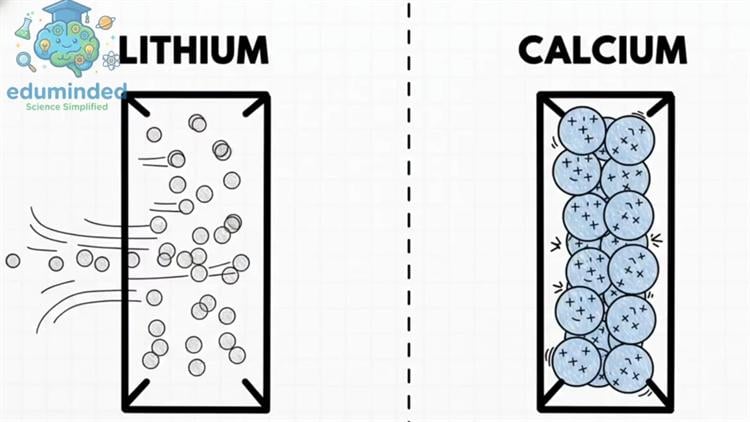 Source: Eduminded via YouTube
Comparison with other multivalent systems
Calcium occupies an interesting middle ground. Compared to magnesium, Ca²⁺ ions exhibit lower polarization strength, which may enable faster diffusion in suitable cathode hosts. Calcium, in contrast to aluminum, can be electrolyted without the use of aggressive chemicals. It can withstand high working voltages since its reduction potential (-2.87 V versus standard hydrogen electrode) is similar to lithium's (-3.04 V versus standard hydrogen electrode).
Continued stability in the interfacial chemistry and electrolyte compatibility with calcium metal is the primary obstacle. In the event that these problems are fixed, CIBs will be able to offer a remarkable compromise between performance, affordability and material availability by combining the large volumetric capacity of multivalent systems with a voltage window that is comparable to LIBs.
Calcium is no longer seen as a specialized option, but rather as a leading contender among technically sound and scalable multivalent solutions for the next generation of energy storage.
Limitations of CIBs
The drawback of CIBs is that they necessitate extensive study prior to becoming suitable for mass manufacture. The laboratory tests have not yet utilized completed batteries, but rather individually produced fibers. A range of materials for electrodes and electrolytes is presently being investigation. The degree to which calcium batteries will surpass the safety of contemporary lithium-ion batteries remains uncertain.
Ca2+ ions create surface layers when exposed to oxygen, water or the electrolyte used in batteries, which is the main problem with calcium. Surfaces that have been oxidized prevent ions from diffusing, which in turn hinders efficient charging and discharging. Therefore, it is crucial to produce an adequate electrolyte. It is also important to avoid using a sulfur cathode because it produces soluble polysulfides that can clog the calcium anode.
Latest advances
Researchers at the Hong Kong University of Science and Technology have developed redox covalent organic frameworks that serve as quasi-solid-state electrolytes (QSSEs) to enhance the performance of CIBs. The carbonyl-rich QSSEs demonstrated an impressive ionic conductivity of 0.46 mS cm-1 and a Ca2+ transport capacity of 0.53 at ambient temperature. The researchers found that Ca2+ ions rapidly traverse the aligned carbonyl groups within the organized pores of the covalent organic frameworks through laboratory experiments and computer simulations. This structured internal pathway enhances ion mobility and overall battery performance. The researchers developed a complete calcium-ion battery with this design, achieving a reversible specific capacity of 155.9 mAh g-1 at a current density of 0.15 A g-1. At a rate of 1 A g-1, the battery maintained over 74.6% of its capacity during 1,000 charge and discharge cycles. The results demonstrate the capacity of redox covalent organic frameworks to substantially enhance CIBs.
Conclusion
While research into CIBs is still in its early stages, developments in electrolyte chemistry and interface engineering suggest that prototype pouch cells could be ready for use in the next decade. When considering grid-scale storage, CIBs could be a good fit if scalability issues are resolved. In this application, sustainability, cost and material availability are more important than gravimetric energy density.
Replacing LIBs in electric vehicles necessitates significant advancements in cycle life, rate capability and manufacturing compatibility.
