
Fujitsu Limited and Fujitsu Kyushu Network Technologies Limited have started selling their Sewer System Flood Detection Solution in Japan, aimed at reducing the damage from torrential rain and flash floods.
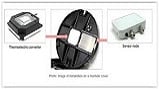 Thermoelectric converter unit turns natural energy into electricity, streamlining operations. Source: Fujitsu.
 This solution uses an attached sensor in a sewer manhole to collect water level data, and wireless communications that transmit this data to the cloud every five minutes. The sensor is powered by a thermoelectric converter that turns energy from temperature differentials into electricity.
The converter, developed by Fujitsu Kyushu Network Technologies, extends the time between battery replacement from 10 months with the sensor being powered by batteries alone-- to five years. This means that in addition to making it possible to achieve dramatic operating efficiencies, deployment costs are also kept in check as power supply installation is unnecessary.
This solution can quickly detect sudden rises in the water level in drainage pipes, enabling rapid measures to limit damage resulting from flooding accompanying locally concentrated downpours. In addition, accumulated water level data can be useful in evaluating sewer drainage plans and setting system-renovation plans.
This solution can quickly detect sudden rises in the water level in drainage pipes, enabling rapid measures to limit damage resulting from flooding accompanying locally concentrated downpours. In addition, accumulated water level data can be useful in evaluating sewer drainage plans and setting system-renovation plans.
Background
In recent years, higher levels of urbanization and numerous instances of torrential downpours have caused increasingly extensive flood damage. There has also been a demand to rebuild and expand drainage systems and faster data collection as flooding countermeasures. In particular, under Japan's Flood Control Act, which was revised and put into effect in fiscal year 2015, water level notification systems have been established for areas neighboring drainage systems, such as underground shopping malls.
One method to sense water levels in drainage pipes, based on fiber optics, involves laying dedicated cables to the measuring point, requiring high deployment costs. Another method, installing battery-powered water-level sensors to the bottom of manhole covers, requires frequent battery changes that affect maintenance costs.
Fujitsu’s solution's hardware was commercialized by Fujitsu Kyushu Network Technologies, based on R&D by Fujitsu Laboratories Ltd. and a fiscal 2015 field trial with the city of Koriyama in Fukushima prefecture. This solution limits systems deployment and operations management costs, and contributes to reductions in damage caused by flooding of drainage systems.
Fujitsu’s solution has a number of benefits:
1. Reduced maintenance costs due to greatly extended battery replacement periods
Power is supplied to the water level sensor and sensor node by using a thermoelectric converter that transforms energy from fluctuations of the manhole cover's heat into electricity. As a result, battery replacement is unnecessary for about five years, under normal conditions. In addition, by miniaturizing and improving the efficiency of the converter, it is the first such unit that can be directly attached to a manhole cover.
2. Measurement locations can be chosen from existing manholes, enabling collection of detailed water level data
Water level data collected by the sensor is transmitted to the cloud via a gateway installed near the manhole. Sensor installation points can be selected freely from among existing manholes, without a power source or the laying of fiber optics, so deployment costs can be kept down. Moreover, the frequency of water level measurements can be modified to meet weather and location characteristics.
3. Real-time visualization of water levels in the drainage system's pipes
From the manhole, the system regularly collects and aggregates pipe water levels, and graphs the information on a map in the water level monitoring application in the cloud. Persons responsible for disaster prevention in the local government can check water level data for each manhole through the internet in their web browsers, and can immediately notify local residents of flood information or take countermeasures to limit damage in the event of flooding.
