
Researchers from the University of Tokyo Institute of Industrial Science, Japan Aerospace Exploration Agency and University of Massachusetts created a new flood forecasting system that could give earlier flood warnings and allow people more time to prepare and evacuate.
Floods are one of the most common natural disasters and, due to climate change, flood frequency is increasing every year. In 2019, Typhoon Hagibis resulted in 86 deaths and $400 billion in damage in Japan. Most of urban Japan lies within the floodplain, putting it at increasing risk.
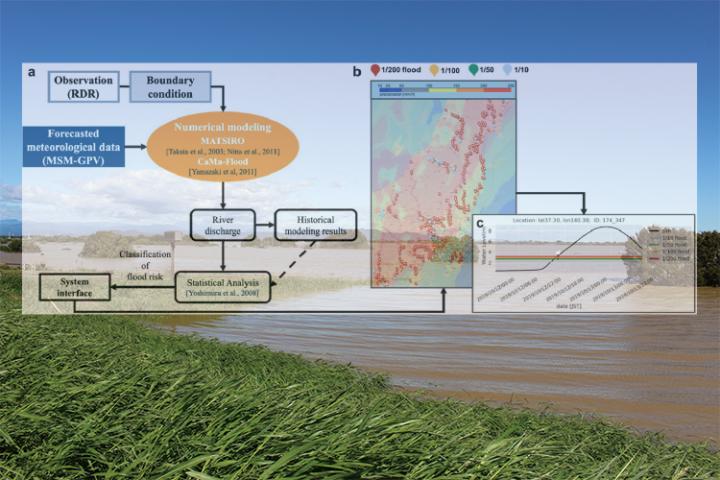 Researchers developed a flood forecasting system that could help protect people and property during typhoons. Source: Institute of Industrial Science, the University of Tokyo
The current flood warning systems provide accurate predictions as to when a flood will hit, but only with a few hours' notice. This does not give enough time to prepare and evacuate to safety. The new system is based on models of land surface and river routes to simulate the movement of water in floodplains combined with meteorlogical data and statistical analysis. The resulting system creates flood predictions for all Japanese rivers.
The main challenge behind flood forecasting is a lack of data. Collecting flood information during a disaster is challenging and dangerous. The team overcame this problem by looking at the location and timing of dike breaks during Typhoon Hagibis. Dike breaks are a good indicator of areas that were flooded during a typhoon. This allowed the researchers to test the ability of their forecasting system to predict floods and their location.
During testing, the model accurately predicted flooding at 91% of the broken dike locations. It also predicted floods with a 32 hour lead time.
A paper on the new model was published in Scientific Reports.
