
PNI Sensor Corp. has introduced what it calls the first co-processor for wearable devices that provides accurate, ultra-low power pedestrian tracking indoors, in urban canyons, and in other environments where global positioning system (GPS) signals are weak or absent.
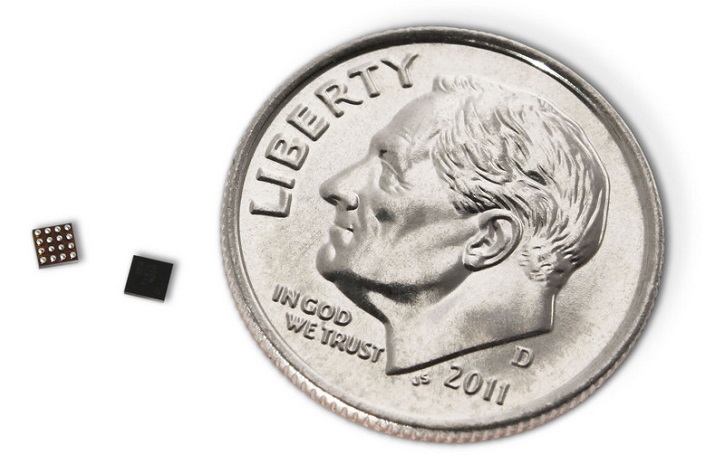 PNI Sensor Corporation's SENtrace pedestrian-tracking co-processor provides position fixes indoors and in other environments where GPS signals don't reach. Image source: PNI Sensor Corp.
SENtrace is a minuscule (1.7 mm x 1.7 mm x 0.5 mm ) custom application-specific IC (ASIC) that uses a small portion of the power that GPS demands. Using embedded algorithms, the solution leverages existing ultra-low power inertial sensors to track users when there is little or no GPS signal. It also dramatically reduces overall battery consumption because it overrides and deactivates power-hungry GPS when it's not needed.
PNI reports that in typical configurations, SENtrace uses one-tenth the power of GPS for computing each location point while providing tracking to one-meter accuracy over 100 meters traveled. SENtrace's algorithms work with any sensor manufacturer's sensors, allowing wearables original equipment manufacturers (OEMs) to select from a wide array of commercially available accelerometers, gyros and magnetic sensors.
Among the applications for SENtrace that PNI foresees in the wearable-device space, the company cites wrist-worn devices for locating lost children or elders and enhanced activity wristbands and smart watches for athletes and fitness enthusiasts.
