
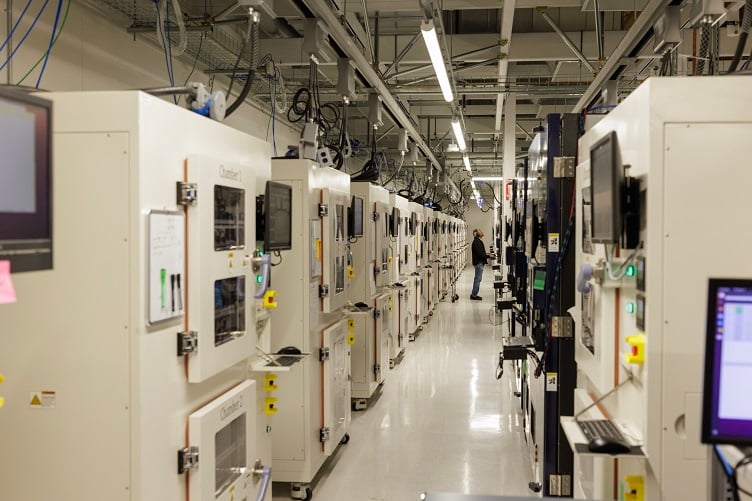
Much of the AI data center discussion focuses on the GPU-everything narrative and for good reason: GPUs are the core performance benchmark for hyperscalers.
However, storage is increasingly being framed as a critical bottleneck in AI data centers.
According to Solidigm, storage and memory are often overlooked, and storage innovation — throughput, latency, data locality and software integration — should be more of a focus for AI data centers.
“We’re in an era where every watt and square inch counts as AI data centers scale exponentially. High-capacity SSDs are the preferred choice for modern AI deployments,” said Avi Shetty, VP of AI market enablement and partnerships at Solidigm. “AI data centers are becoming data-bound, not compute-bound.”
Shetty said that without efficient storage, GPUs sit idle, which leads to higher costs and limited performance. To scale AI, storage must be treated as a first-order priority.
This is backed by research from International Data Corp (IDC). According to its latest enterprise storage system (ESS) tracker, storage vendors are reporting record or near-record revenue tied to AI workload requirements and data centers. All-flash platforms that target GPU-to-storage bandwidth requirements for AI training and inferencing are among the fastest-growing product categories, IDC said.
This includes subscription and as-a-service storage models gaining traction as hyperscalers seek consumption-aligned procurement for AI infrastructure builds.
“The first quarter of 2026 marks a turning point for the enterprise storage market,” said Juan Seminara, research director for enterprise infrastructure at IDC. “After two years of being eclipsed by server and AI compute spending, storage is returning to double-digit growth performance.”
Much of that growth is driven by AI demand for all-flash arrays (AFA), which crossed the 50% revenue threshold for the first time, Seminara said.
In the first quarter of 2026, AFA generated $4.9 billion, a 32.7% year-over-year growth, and 52.6% of total enterprise storage system (ESS) revenue, IDC reported.
But the demand surge has a supply-side problem attached to it.
Market research firm TrendForce reports that major NAND flash suppliers will add virtually no new production capacity in 2026, meaning the shortage is structural, not a blip.
That's already pushing storage orders toward high-capacity QLC enterprise SSDs, where Solidigm competes directly. TrendForce noted that Solidigm specifically benefited from strong orders for high-capacity QLC SSDs in Q1 2026.
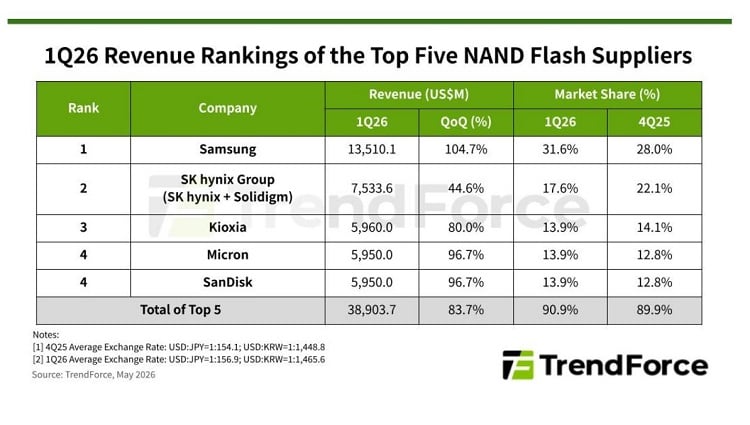 Source: TrendForce
The data path matters
Solidigm said that it isn’t just about the NAND flash and large SSDs, it is more the data path that matters.
It is not about bigger SSDs because they can’t feed GPUs fast enough, bandwidth per drive is the critical element, Shetty said. Additionally, tail latency, not averages, drives AI performance for inference and RAG.
Other data path elements Solidigm highlights include:
- Data locality — Where the data sits relative to the GPUs matters as much as speed.
- Checkpointing and writing — Training isn’t just about reading as write performance and recovery times are often underestimated.
- Software stack — The impact of systems like object/file layers (e.g. MinIO, WEKA, VAST) heavily influence SSD behavior and efficiency.
- Thermals and density — Storage cooling, like liquid-cooled SSDs, is becoming a must-have for high-density AI racks.
“It’s not just NAND or SSD specs, it’s how the entire storage stack feeds the GPUs efficiently,” Shetty said.
And Solidigm is planning on deepening its R&D, labs and innovation into the data center storage sector by expanding its U.S. footprint at its Rancho Cordova, California, location.
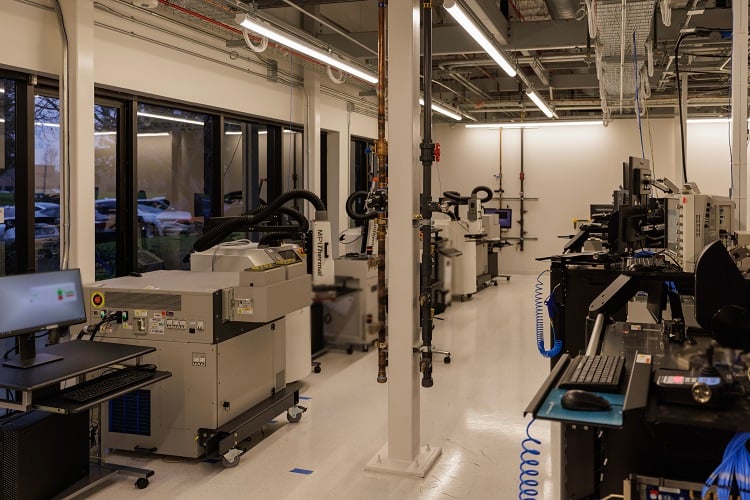 At Solidigm’s Rancho Cordova, California, campus, the company has developed storage systems for AI data centers like its liquid-cooled SSD for fanless GPU systems. Source: Solidigm
Larger campus, larger impact
In April, Solidigm announced it had already reached its initial $100 million investment goals at the Greater Sacramento, California, facility and planned to continue to invest in local talent and technology including what it claims is the first liquid-cooled SSD for fanless GPU systems in data centers.
Shetty said the company is exploring initiatives with local and nearby universities to advance technology through learning programs and talent pipeline recruitment.
This expansion is also drawing attention from regional officials eyeing a bigger slice of the semiconductor ecosystem.
According to Rancho Cordova, California, City Manager Micah Runner, Solidigm’s growth is adding to the Sacramento regional semiconductor and advanced technology ecosystem. It signals that the region can support complex, innovative and R&D-driven operations for the hottest technologies like data centers.
“Beyond visibility, it contributes to real ecosystem momentum — talent attraction, supply chain activity, and opportunities for collaboration,” Runner told GlobalSpec. “That’s particularly important as we advance our AI and robotics ecosystem, where semiconductor technologies like high-performance storage and compute are foundational.”
Additionally, the expansion in Rancho Cordova and Greater Sacramento builds workforce pipelines, supports infrastructure improvements and helps advocate for policies for tech to allow the region to remain competitive in the tech sector.
“Rancho Cordova has been very intentional about creating an environment where innovative companies can grow and succeed,” Runner said. “That starts with being responsive and easy to work with, whether that’s streamlining permitting, supporting site readiness, or coordinating closely with regional partners.”
The city has made long-term investments in infrastructure and incentive programs as well as working closely with education and workforce partners to create opportunities for business and employees, Runner added.
