
Panasonic Corporation has developed a soft, flexible, and stretchable polymer resin film using its proprietary stretchable resin technology. The material is an insulating film material that stretches and returns to its original shape, a feature that is hard to find in conventional flexible materials.
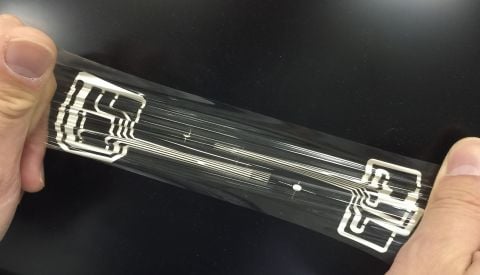 Panasonic stretchable resin film. (Source: Panasonic)The material adapts to desired manners of folding and to varying free-form surfaces, substantially reducing existing design constraints. For example, it enables the construction of soft and stretchable electronic devices that are adaptable to various forms, such as of clothing and the body. The material can be deployed in a broad range of applications, from wearable devices to sensors, displays, and robots.
The stretchable resin exhibits a tensile elongation of 2.5 times or more. It employs a design technology to allow the material to have both soft and rigid components. This method differs from the conventional method of adding an elastomer. This technology uses a three-dimensional cross-linked structure of thermosetting resin to relax stresses arising from stretch and restore. While ensuring compatibility between elasticity and stress relaxation, Panasonic developed an insulating material, which, although made of a thermosetting resin, stretches and returns to its original shape to enable repeated use.
Panasonic also developed a conductive paste was produced by combining the stretchable resin, used as a binder, with silver filler. The conductive paste retains a conductive path, hence conductivity, even after stretch and restore. The company developed a technology designed to form a thin transparent conductive layer, comprising conductive carbon nanotubes of a high aspect ratio on a base material of a stretchable resin film produced with the optimal materials designed for stretch and restore.
