
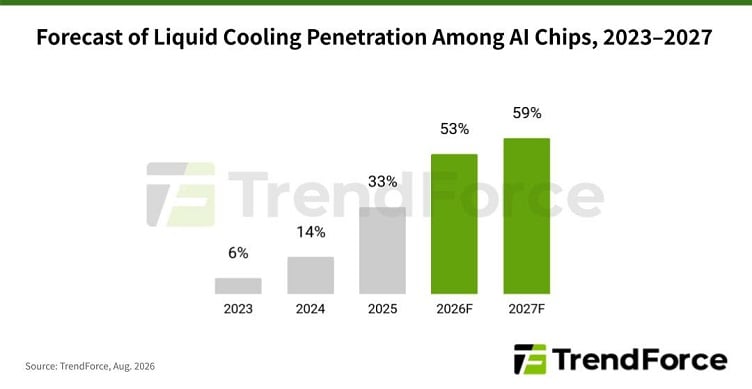
Liquid cooling is projected to reach a 53% penetration in high-end AI infrastructure, on its way to being standard among AI chips, according to new data from market research firm TrendForce.
The rapid iteration of AI chip performance from Nvidia, AMD and Google is pushing AI processors above 1 kilowatt and rack-scale AI server solutions are now consuming hundreds of kilowatts.
By 2027, liquid cooling is projected to approach 60% penetration, showing the rapid rise in this AI data center technology.
Rising fast
AI investment from tier-2 data center operators and Chinese-based cloud service providers (CSPs) for overseas AI projects are expected to double shipments of Nvidia’s GB/VR rack-scale solutions in 2026. This will result in strong AI infrastructure investment that will sustain overall GPU rack demand as shipments grow by more than 30% year-over-year, TrendForce said.
AMD is expected to focus on its Helios AI rack-scale platform, which brings together central processing units (CPUs), graphics processing units (GPUs) and high-speed interconnects, with large-scale shipments targeted for 2027. The company's MI450 platform is expected to ship alongside Helios, with the next-generation MI500 platform positioned to follow and go head-to-head with Nvidia's Rubin Ultra rack.
All these platforms have fully adopted liquid cooling, TrendForce said.
Most aggressive
TrendForce noted that Google has been the most aggressive in adopting liquid cooling with the technology used in over 80% of its AI servers.
The company has taken the lead among CSPs by extending liquid cooling from individual servers to rack-scale system designs, which is also driving overall adoption of liquid cooling technologies.
With Nvidia’s Vera Rubin platform expected to adopt a fanless, all-liquid-cooled design, this will also likely lead to further adoption of the technology.
What is liquid cooling?
Liquid cooling systems include parts such as:
- Cold plates
- Manifolds
- Coolant distribution units (CDUs)
These provide a higher level of cooling efficiency compared to air cooling. Most systems are integrated around AI processors, GPUs and CPUs where liquid cooling circulates to dissipate heat quickly from these processors.
Major cold plate suppliers include Cooler Master, AVC, Boyd, Auras and Ecolab. These companies stand to benefit the most from adoption of liquid cooling as it penetrates the market further.
