
Baumer has introduced a compact sensor based on resistance temperature detection (RTD) technology that is designed to meet stringent hygienic standards, while delivering highly accurate measurements. The TER8 temperature sensor is available in a version supporting front-flush installation and in two immersion-sleeve variants (which protrude 20 mm or 50 mm into the process media, depending on model). For maximum media compatibility, all wetted parts are made of polyether ether ketone (PEEK) — a polymer thermoplastic known for its chemical resistance.
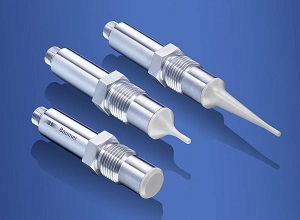 Baumer's TER8 RTD temperature sensor comes in front-flush and immersion-sleeve models. (Source: Baumer)Measuring process temperatures ranging from -40°C to 125°C, the TER8 is based on Baumer's TE2 sensor series, and adopts the mechanical and electromechanical properties of that product family. The compact 18 mm diameter TER8 sensor housing fits into tight, difficult-to-access spots. The sensor's mounting method uses no elastomers, while 3A and EHED compliance ensures optimum hygienic capabilities free from maintenance.
The front-flush version of the sensor — in which the media-facing side of the sensor mounts flush with the inside of the tank or pipe in which it is mounted — can be directly integrated into the process and avoids interfering with agitators or any other inside-tank assemblies. In pipelines, it has negligible impact on media flow and permits the use of “pigs” (devices placed inside the pipe, which are pulled, pushed, or crawl through the pipe under their own power, to perform such functions as inspecting for internal pipeline corrosion).
Unlike similar sensors having metal sensor inserts, the TER8 leaves no sealing points exposed to the process media. Hermetic sealing on the process side of the sensor prevents steam ingress. Specialized thermal insulation between the sensing element and housing ensures that the temperature being measured is that of the media, minimally influenced by external ambient impacts.
