Key takeaways:
- Interference with GPS has pushed vendors toward navigation that doesn’t depend only on satellites.
- Anello has put a silicon photonics optical gyroscope once found mainly in fighter jets and high-end submarines into systems for drones, boats, robotaxis and farm equipment.
- GPS loss isn’t only a war-zone problem, since tunnels, barns, mines and urban canyons cut it off too.
Mario Paniccia spent years at Intel, leading its silicon photonics work before turning the technology toward navigation.
Today, he is CEO and co-founder of Santa Clara, California-based Anello Photonics, a company building chip-scale silicon photonics optical gyroscopes and modules to keep drones, farm equipment, automotive vehicles and other autonomous machines on course when GPS fails.
GPS is a ubiquitous technology that runs much of the physical world’s navigation capabilities. The problem is that it can be jammed or spoofed.
Since the war in Ukraine, interference with GPS has pushed the need for technologies that don’t depend only on satellite navigation, allowing aerospace and other vehicles to follow the correct path if GPS gets hacked, Paniccia said.
 Mario Paniccia is the co-founder and CEO of Anello Photonics. “We've created a sensor that used to be found predominantly in fighter jets and high-end submarines, and we've brought it to the autonomous world: drones, autonomous boats, robotaxis, farming, construction and agriculture,” Paniccia said.
Older optical gyroscopes were built from expensive, and usually large, components assembled by hand, he added.
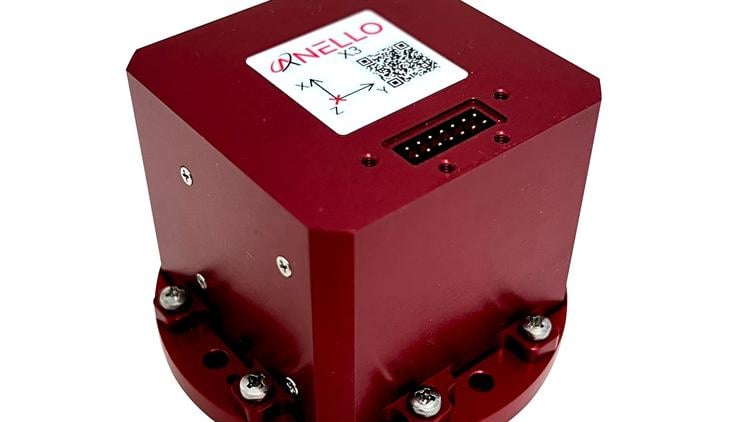
Anello’s silicon photonics optical gyroscope, called SiPhOG, integrates the sensor into a portable form factor that can be mounted on small machines, allowing them to be resistant to spoofing.
Why GPS is the weak point
“The reality is that everything relies on GPS, and it can easily be jammed and spoofed,” Paniccia said. “It's not just war zones. Everything is being jammed, even military code. It affects civilians too: planes, Uber drivers, anyone whose phone doesn't work.”
Paniccia said there are two ways around this: high-end fiber-optic gyros, which can cost millions of dollars; and visual navigation like lidar and cameras, as well as radar — but these have issues over water, snow and clouds.
The gap in the gyroscope market
The military solutions allow a submarine to go underwater for two months and come back above the surface within 1 meter of its destination, Paniccia said.
“But that’s a $2 million gyro and about the size of a desk,” he added.
In the middle, there are fiber optic gyros and ring laser gyros that run anywhere between $40,000 and $150,000.
Anello saw a gap for a low-cost, high-precision silicon photonics optical gyroscope that could be used for industrial, defense and eventually automotive applications when automated driving advances.
Anello’s SiPhOG optical gyroscopes are integrated into systems that also contain accelerometers, temperature sensors and other types of MEMS. An aerial system has three SiPhOGs inside, while autonomous ground vehicles have a single SiPhOG for ground navigation.
Current and future use cases for silicon photonics optical gyroscopes
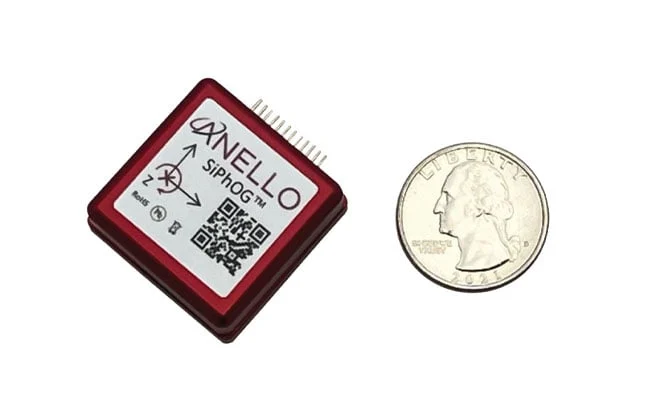 Anello's SiPhOG MEMS sensor that is integrated into systems for use in land, air and sea vehicles. Source: Anello Anello is developing silicon photonics optical gyroscopes for land, air and sea, but it also sees a future where these systems could be used in handheld, low-power devices that could be carried by a soldier or a civilian anywhere.
The company is also looking to space as a new use case for these gyros due to the same expectations of low power, low weight, small size but high-performance demand.
“In industrial settings you lose GPS in tunnels, under bridges, in urban canyons, barns, caves and mines,” Paniccia said. “In war-torn areas, it's real jamming and spoofing. It's the same technology and the same products. Only the way the signal is lost differs.”
The case for silicon photonics optical gyroscopes in automotive
One use case Anello was originally targeting, navigation in autonomous vehicles, is still on the table as the technology begins to emerge as a viable business.
Anello is developing silicon photonics gyros that have two antennas that can be plug-and-play into a cigarette lighter. The portable device could be used for trucking fleets traveling long distances across terrain where GPS may not work or in military vehicles deployed in areas where GPS might be jammed.
The company has tested the solution, and the device was 99.9% accurate over 100 kilometers when GPS was disconnected, Paniccia said.
